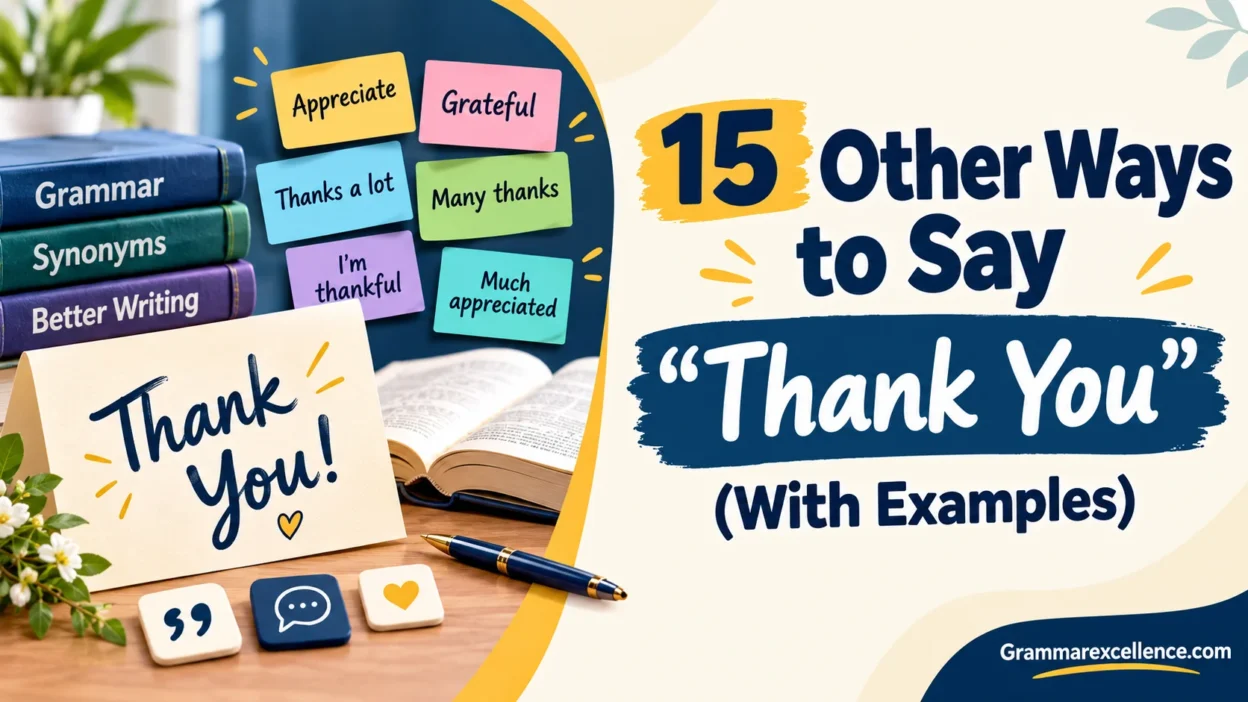
In everyday communication, Thank you is a simple and natural expression of gratitude, kindness, and respect. You can use thank you after receiving help, a gift, or a kind act, whether you are speaking with friends, co-workers, or everybody in your life. The right tone, phrase, and words can make your English sound clear and sincere while helping you express appreciation in a natural way.
The meaning of thank you can change slightly depending on the situation and context. For casual conversations, thanks or Thanks a ton can sound friendly, while thank you very much, Thank you kindly, or My sincerest thanks may be more polite and formal in a work situation or workplace email. When you want to show heartfelt gratitude, expressions such as I’m truly grateful and thank you so much can communicate deeper appreciation and create a positive impression.
A sincere thank you message, thank you card, or handwritten note can make your appreciation more meaningful and personal. Whether you are thanking someone for small favors, gifts, kind deeds, or simply being there, choosing the right expression can strengthen relationships and show how you feel. These natural alternatives give you a simple way to express appreciation while making your message more memorable.
What Does “Thank You” Mean?
“Thank you” is a common English expression used to show gratitude, appreciation, or politeness when someone gives you something, helps you, does something kind, or provides a service. It can be used for something small, such as holding a door open, or something meaningful, such as helping you through a difficult situation.
The phrase is generally positive, polite, and widely appropriate. Its exact feeling depends on context and delivery. Saying “thank you” with a smile may sound warm and friendly, while writing “Thank you for your assistance” in a business email sounds more formal. The phrase can also be strengthened with words such as “very much” or “so much” when you want to show greater appreciation.
Common Situations Where “Thank You” Is Used
“Thank you” appears in almost every area of everyday English. People use it in face-to-face conversations, text messages, emails, social media posts, customer communication, school, and professional settings.
You might say “thank you” when a friend helps you move, when a teacher explains something, when a colleague completes a task, or when a customer provides useful information. It is also common after receiving a gift, compliment, favor, invitation, recommendation, or service.
Because “thank you” is so versatile, repeating it can sometimes make communication feel predictable. An alternative can add a more specific feeling. For example, “I really appreciate it” emphasizes appreciation, while “I can’t thank you enough” communicates especially strong gratitude. Choosing the right wording helps your message match the relationship and situation.
Is It Professional or Polite to Say “Thank You”?
Yes. “Thank you” is both polite and professional and is suitable for most workplace situations. It is simple enough for everyday conversation but respectful enough for business emails, customer communication, academic correspondence, and formal messages.
The level of formality can be adjusted through the surrounding words. “Thanks!” sounds casual, while “Thank you for your assistance” sounds more professional. Similarly, “Thank you so much for helping me” feels warmer and more personal. The phrase itself is rarely a problem; the important factor is whether the overall wording fits the relationship and context.
Advantages and Disadvantages of Saying “Thank You”
Advantages
The biggest advantage of “thank you” is its clarity and versatility. Almost every English speaker understands it immediately, and it works across formal and informal situations. It is also emotionally flexible: depending on the wording and delivery, it can communicate simple courtesy, sincere appreciation, or deep gratitude.
Another benefit is that “thank you” is usually safe and respectful. It does not require complicated vocabulary, making it especially useful for English learners and for situations where you want to avoid misunderstanding.
Disadvantages
Because “thank you” is extremely common, it can sometimes feel routine or less personal when repeated frequently. It may not fully express the strength of your feelings when someone has done something particularly meaningful.
In some situations, a more specific expression can communicate your intention better. For example, “I appreciate your patience” identifies exactly what you value, while “I’m deeply grateful” conveys stronger emotion. These alternatives should not replace “thank you” unnecessarily, but they can provide greater emotional or contextual nuance.
Synonyms For “Thank You”
- Thanks
- Thank you so much
- Many thanks
- I really appreciate it
- I appreciate your help
- Much appreciated
- I’m grateful
- I’m deeply grateful
- I can’t thank you enough
- I owe you one
- You’re a lifesaver
- Thanks a lot
- My thanks
- I’m indebted to you
- Cheers
1. Thanks
Meaning
“Thanks” is a shorter and more casual way to express gratitude. It communicates the same basic idea as “thank you,” but it generally feels lighter and more conversational.
Definition
Thanks is an informal expression used to show appreciation for something someone has done, given, or said.
Detailed Explanation
“Thanks” is one of the most natural alternatives to “thank you” in everyday English. It is especially common in conversation, texting, chats, and friendly messages. It can sound warm without being overly emotional. However, in a highly formal letter or sensitive professional situation, the complete phrase “thank you” may sound more polished.
Scenario Examples
Scenario: A friend sends you a useful website.
Example: “Thanks! This is exactly what I needed.”
Scenario: A colleague gives you a document you requested.
Example: “Thanks for sending that over.”
Scenario: Someone holds the door open for you.
Example: “Thanks!”
Best Use
Use “thanks” in casual conversation, texting, friendly emails, chats, and everyday interactions.
Tone
Tone: Casual, friendly, natural
It feels relaxed and straightforward, making it especially suitable for people you know well.
2. Thank You So Much
Meaning
“Thank you so much” expresses stronger or warmer gratitude than a simple “thank you.” It is useful when you want the other person to know that their action genuinely mattered to you.
Definition
Thank you so much is a warm expression used to show sincere and often enthusiastic appreciation.
Detailed Explanation
This expression adds emotional warmth to the standard phrase. It can be used for both small and significant favors, although the surrounding situation determines how strong it sounds. It works well when someone has gone out of their way to help you. In professional communication, it can also be appropriate when the relationship is reasonably friendly.
Scenario Examples
Scenario: A friend helps you prepare for an important interview.
Example: “Thank you so much for helping me practice. I feel much more confident now.”
Scenario: A relative sends you a thoughtful gift.
Example: “Thank you so much for the beautiful gift. I really love it.”
Scenario: A colleague stays late to help finish a project.
Example: “Thank you so much for staying late and helping us finish this.”
Best Use
Use it in personal messages, friendly communication, appreciation emails, and situations involving meaningful help or kindness.
Tone
Tone: Warm, appreciative, sincere
The words “so much” make the gratitude feel more emotionally expressive.
3. Many Thanks
Meaning
“Many thanks” is a concise way to communicate strong appreciation, particularly in written communication.
Definition
Many thanks is a polite expression meaning that you are giving someone a great deal of thanks or appreciation.
Detailed Explanation
“Many thanks” is more common in written English than in casual conversation. It can work well in emails, letters, and professional messages without sounding excessively formal. Compared with “thanks,” it feels more polished; compared with “I’m deeply grateful,” it is less emotional.
Scenario Examples
Scenario: Someone sends you information you requested by email.
Example: “Many thanks for sending the details so quickly.”
Scenario: A colleague provides useful feedback on a document.
Example: “Many thanks for your helpful comments.”
Scenario: Someone confirms an appointment.
Example: “Many thanks for confirming the meeting.”
Best Use
Use “many thanks” in emails, professional correspondence, letters, and polite written communication.
Tone
Tone: Polite, professional, warm
It offers a courteous middle ground between casual “thanks” and highly formal expressions of gratitude.
4. I Really Appreciate It
Meaning
“I really appreciate it” communicates genuine appreciation for something another person has done.
Definition
I really appreciate it means that you value and are grateful for someone’s action, help, kindness, or effort.
Detailed Explanation
This expression focuses on the value of the other person’s action, rather than simply offering thanks. It sounds natural when someone has made an effort on your behalf. “Really” adds sincerity without making the expression overly dramatic. It is usually more conversational than formal.
Scenario Examples
Scenario: A neighbor collects your mail while you are away.
Example: “Thanks for looking after everything while I was gone. I really appreciate it.”
Scenario: A coworker helps you solve a difficult problem.
Example: “I really appreciate it. I was stuck on that issue all morning.”
Scenario: A friend listens when you need someone to talk to.
Example: “I really appreciate you being there for me.”
Best Use
Use it in everyday conversation, workplace communication, personal messages, and friendly emails.
Tone
Tone: Warm, sincere, conversational
It feels personal because it emphasizes that the person’s effort genuinely mattered.
5. I Appreciate Your Help
Meaning
“I appreciate your help” directly recognizes someone’s assistance or support.
Definition
I appreciate your help is a polite expression used to acknowledge and value assistance received from another person.
Detailed Explanation
Unlike the general “thank you,” this expression identifies the specific thing you are grateful for: the person’s help. That makes it particularly useful in professional and academic settings. It sounds respectful without being excessively formal. It can also feel more thoughtful because it shows that you noticed the person’s contribution.
Scenario Examples
Scenario: A colleague helps you complete a report.
Example: “I appreciate your help with the report. It made the process much easier.”
Scenario: A teacher explains a difficult topic.
Example: “I appreciate your help. I understand the topic much better now.”
Scenario: A customer-service representative resolves an issue.
Example: “I appreciate your help in getting this problem resolved.”
Best Use
Use it in professional emails, workplace conversations, academic communication, customer communication, and situations involving practical assistance.
Tone
Tone: Professional, polite, appreciative
It is especially useful when you want to sound respectful while clearly acknowledging someone’s assistance.
6. Much Appreciated
Meaning
“Much appreciated” is a concise way of saying that someone’s help, effort, or action is greatly valued.
Definition
Much appreciated means that you are very grateful for something someone has done.
Detailed Explanation
This phrase is shorter and somewhat more direct than “I really appreciate it.” It is common in workplace communication and informal professional messages, especially when the context already makes the subject clear. For example, “Your quick response is much appreciated” sounds more polished than simply saying “Thanks.” On its own, “Much appreciated” can sound slightly businesslike, depending on the relationship.
Scenario Examples
Scenario: A colleague sends an urgent document.
Example: “Much appreciated. I’ll review it this afternoon.”
Scenario: Someone responds quickly to your request.
Example: “Your quick response is much appreciated.”
Scenario: A team member covers a task for you.
Example: “Much appreciated for taking care of that while I was away.”
Best Use
Use it in work emails, workplace chats, short professional messages, and concise written communication.
Tone
Tone: Professional, concise, appreciative
Its strength is its brevity, although a complete sentence may sound more natural in formal writing.
7. I’m Grateful
Meaning
“I’m grateful” expresses a clear feeling of gratitude and is often more personal or emotional than a simple “thank you.”
Definition
I’m grateful means that you feel thankful because of someone’s kindness, help, support, or another positive action.
Detailed Explanation
This phrase focuses on your emotional response rather than simply performing an act of politeness. It works particularly well when the help or kindness has genuine personal significance. “I’m grateful” can be used in everyday communication, but it may sound more heartfelt than “thanks.” It is especially appropriate when you want your appreciation to feel sincere.
Scenario Examples
Scenario: A friend supports you during a difficult period.
Example: “I’m grateful that you stayed by my side when things were difficult.”
Scenario: A mentor gives you valuable career advice.
Example: “I’m grateful for all the guidance you’ve given me.”
Scenario: Someone gives you an important opportunity.
Example: “I’m truly grateful for the opportunity.”
Best Use
Use it in personal messages, heartfelt conversations, appreciation notes, professional acknowledgments, and meaningful situations.
Tone
Tone: Sincere, warm, heartfelt
It communicates more personal emotion than a routine “thank you.
8. I’m Deeply Grateful
Meaning
“I’m deeply grateful” expresses strong and sincere gratitude, usually when someone’s action has had significant personal importance.
Definition
I’m deeply grateful means that you feel a very strong sense of appreciation for someone’s kindness, support, help, or generosity.
Detailed Explanation
The word “deeply” gives this expression considerable emotional weight. It is not normally necessary for minor favors, such as someone passing you a pen. Instead, it fits situations where someone has provided major support, shown exceptional kindness, or made a meaningful difference. It can appear in both personal and formal writing.
Scenario Examples
Scenario: Someone supports you during a major life challenge.
Example: “I’m deeply grateful for your support during such a difficult time.”
Scenario: A teacher has had a lasting influence on your education.
Example: “I’m deeply grateful for everything you taught me.”
Scenario: An organization provides meaningful assistance.
Example: “We are deeply grateful for your generous support.”
Best Use
Use it in formal letters, speeches, heartfelt messages, acknowledgments, and situations involving significant gratitude.
Tone
Tone: Deeply sincere, emotional, respectful
The expression carries more emotional weight than ordinary everyday thanks.
9. I Can’t Thank You Enough
Meaning
“I can’t thank you enough” means that you feel your gratitude is so strong that ordinary words do not seem sufficient.
Definition
I can’t thank you enough is an emphatic expression used when someone has done something especially helpful, generous, or meaningful.
Detailed Explanation
This is not a literal statement that you are unable to say “thank you.” It is an idiomatic expression of very strong appreciation. It works especially well after a major favor or act of kindness. Because it carries emotional intensity, it may sound excessive if used for something very minor.
Scenario Examples
Scenario: Someone helps you during an emergency.
Example: “I can’t thank you enough for getting me home safely.”
Scenario: A colleague takes over your responsibilities while you deal with a personal issue.
Example: “I can’t thank you enough for covering my work.”
Scenario: A friend helps you achieve an important goal.
Example: “I can’t thank you enough for believing in me.”
Best Use
Use it in personal communication, heartfelt messages, major favors, emotional conversations, and sincere appreciation.
Tone
Tone: Strong, heartfelt, emotional
It is more intense than an ordinary “thank you” and should be used when that stronger feeling is appropriate.
10. I Owe You One
Meaning
“I owe you one” is a casual way of saying that you appreciate someone’s help and would like to return the favor.
Definition
I owe you one means that you are grateful for someone’s help and feel that you should do something helpful for them in return.
Detailed Explanation
This expression does more than communicate gratitude. It suggests a sense of reciprocity or friendly obligation. It is normally used after a favor between friends, relatives, or familiar coworkers. It would not usually be the best choice for formal customer correspondence because it is conversational and implies a future favor.
Scenario Examples
Scenario: A friend gives you a ride home.
Example: “Thanks for the ride. I owe you one.”
Scenario: A coworker covers your shift.
Example: “I owe you one for taking my shift at the last minute.”
Scenario: A friend lends you something you urgently need.
Example: “You saved me today. I owe you one.”
Best Use
Use it in casual conversation, texting, friendly workplace relationships, and informal personal communication.
Tone
Tone: Casual, friendly, reciprocal
It sounds relaxed and often suggests that you intend to return the favor.
11. You’re a Lifesaver
Meaning
“You’re a lifesaver” is an informal expression used when someone’s help solves a difficult or urgent problem.
Definition
You’re a lifesaver means that someone’s assistance was extremely useful at an important moment.
Detailed Explanation
This phrase is usually figurative, not literal. You say it when someone’s action has rescued you from a stressful, inconvenient, or difficult situation. It is stronger and more expressive than a standard “thank you,” but it is also more casual. It should generally be reserved for situations where the person’s help feels especially valuable.
Scenario Examples
Scenario: A colleague sends you an important file just before a deadline.
Example: “You’re a lifesaver! I thought I had lost that file.”
Scenario: A friend brings you something you urgently need.
Example: “You’re a lifesaver. I really needed this today.”
Scenario: Someone helps you fix a problem before an important event.
Example: “You’re a lifesaver for getting this sorted out so quickly.”
Best Use
Use it in casual conversation, friendly messages, texting, and situations involving urgent or particularly helpful assistance.
Tone
Tone: Casual, enthusiastic, appreciative
It adds energy and personality to your expression of gratitude.
12. Thanks a Lot
Meaning
“Thanks a lot” can express strong appreciation, but its meaning depends heavily on context and tone.
Definition
Thanks a lot is an informal expression that can mean genuine gratitude or, in some situations, sarcastic displeasure.
Detailed Explanation
When said warmly, “Thanks a lot” can mean that you are very thankful. However, the same words can be used sarcastically when someone has caused a problem. For example, “Thanks a lot—you deleted the file” clearly does not express genuine gratitude. Because of this ambiguity, context and tone matter. If you want to avoid any possibility of misunderstanding, “Thank you so much” is usually clearer for sincere appreciation.
Scenario Examples
Scenario: A friend helps you organize an event.
Example: “Thanks a lot for helping me with everything.”
Scenario: Someone gives you useful directions.
Example: “Thanks a lot. I really appreciate it.”
Scenario: A person accidentally causes a problem.
Example: “Thanks a lot—you’ve just spilled coffee on my notes.”
Best Use
Use it in casual conversation, friendly messages, and informal situations, especially when your tone clearly communicates whether the gratitude is genuine.
Tone
Tone: Casual, appreciative—or sarcastic depending on context
This expression requires more attention to tone and situation than many other alternatives.
13. My Thanks
Meaning
“My thanks” is a more formal and literary way to express appreciation.
Definition
My thanks is a formal expression used to convey gratitude or appreciation, particularly in writing or public acknowledgments.
Detailed Explanation
“My thanks” is less common in everyday conversation than “thank you.” It often appears in formal writing, speeches, acknowledgments, and carefully worded messages. It can sound elegant, but it may feel unusual or overly formal in a casual text. The expression is most natural when the surrounding language is also relatively formal.
Scenario Examples
Scenario: A speaker acknowledges people who helped organize an event.
Example: “My thanks to everyone who contributed their time and effort.”
Scenario: An author acknowledges someone’s assistance.
Example: “My thanks to the editorial team for their careful work.”
Scenario: A formal written acknowledgment.
Example: “Please accept my thanks for your continued support.”
Best Use
Use it in formal writing, speeches, acknowledgments, ceremonial communication, and polished correspondence.
Tone
Tone: Formal, respectful, appreciative
It has a more traditional and literary quality than everyday “thanks.”
14. I’m Indebted to You
Meaning
“I’m indebted to you” expresses very strong gratitude, often suggesting that someone’s help was so valuable that you feel you owe them something.
Definition
I’m indebted to you means that you feel deeply grateful to someone and recognize a significant obligation created by their help or kindness.
Detailed Explanation
This phrase is considerably more formal and serious than “thank you.” It can describe a strong sense of gratitude or obligation, particularly after substantial assistance. It does not necessarily mean that you literally owe the person money or a favor. Because of its formal and somewhat weighty character, it is less suitable for everyday casual interactions.
Scenario Examples
Scenario: A mentor provides major professional guidance.
Example: “I’m indebted to you for the guidance you gave me at the beginning of my career.”
Scenario: Someone provides significant support during a difficult situation.
Example: “I’m deeply indebted to you for everything you did for my family.”
Scenario: A formal letter expressing substantial gratitude.
Example: “I remain indebted to you for your generous assistance.”
Best Use
Use it in formal correspondence, serious acknowledgments, literary writing, and situations involving significant assistance or long-lasting gratitude.
Tone
Tone: Formal, serious, deeply appreciative
It conveys a stronger sense of obligation than most everyday alternatives.
15. Cheers
Meaning
“Cheers” can be used as an informal expression of thanks, particularly in some varieties of British and other English-speaking usage.
Definition
Cheers is a casual expression that can mean “thank you” in certain English-speaking contexts.
Detailed Explanation
“Cheers” is highly dependent on regional usage and context. In British English, it is commonly used informally to thank someone, especially after a small favor or helpful action. It can also mean a toast, so the surrounding situation determines its meaning. It is generally not the best choice for formal business correspondence or communication with someone unfamiliar with this usage.
Scenario Examples
Scenario: A friend hands you a cup of coffee.
Example: “Cheers!”
Scenario: A coworker sends you a useful document in an informal workplace chat.
Example: “Cheers for sending that over.”
Scenario: A friend helps you with a small task.
Example: “Cheers, I appreciate it.”
Best Use
Use it in casual conversation, informal messages, friendly chats, and contexts where this regional usage is familiar.
Tone
Tone: Casual, friendly, informal
It can sound very natural in the right regional and social context but is less suitable for formal communication.
FAQs
Q1. What is another way to say “Thank You”?
There are many natural alternatives, including “Thanks,” “I really appreciate it,” “Many thanks,” “I’m grateful,” and “Thank you so much.” The best choice depends on the situation. For example, “Thanks” is casual, while “I’m deeply grateful” expresses stronger emotion.
Q2. What does “Thank You” mean?
“Thank you” is a polite expression used to show gratitude or appreciation. People use it when someone helps them, gives them something, provides a service, offers kindness, or does something they value.
Q3. Is “Thank You” professional?
Yes. “Thank you” is professional, polite, and widely appropriate. It can be used in workplace emails, customer communication, academic messages, meetings, and formal correspondence. The surrounding wording can make the message more formal or more casual.
Q4. What is a more polite way to say “Thank You”?
“Thank you” is already polite, but alternatives such as “I appreciate your help,” “Many thanks,” or “Thank you so much” can add a particular quality to the message. “I appreciate your help” is especially useful when you want to acknowledge someone’s specific assistance.
Q5. Which alternative works best in formal communication?
For formal communication, “Many thanks,” “I appreciate your help,” “My thanks,” and “I’m deeply grateful” can work depending on the situation. The choice should match the seriousness and purpose of the message rather than simply using the most formal-sounding phrase.
Conclusion
Thank you is a simple but powerful way to express gratitude, kindness, and respect. Whether you use a casual phrase like thanks, a formal expression like My sincerest thanks, or a heartfelt message such as I’m truly grateful, the right expression depends on the situation, context, and relationship with the recipient. A sincere thank you message can strengthen relationships, show appreciation, and leave a lasting positive impression. By choosing natural words that match how you feel, you can make every expression of gratitude more personal, meaningful, and memorable.