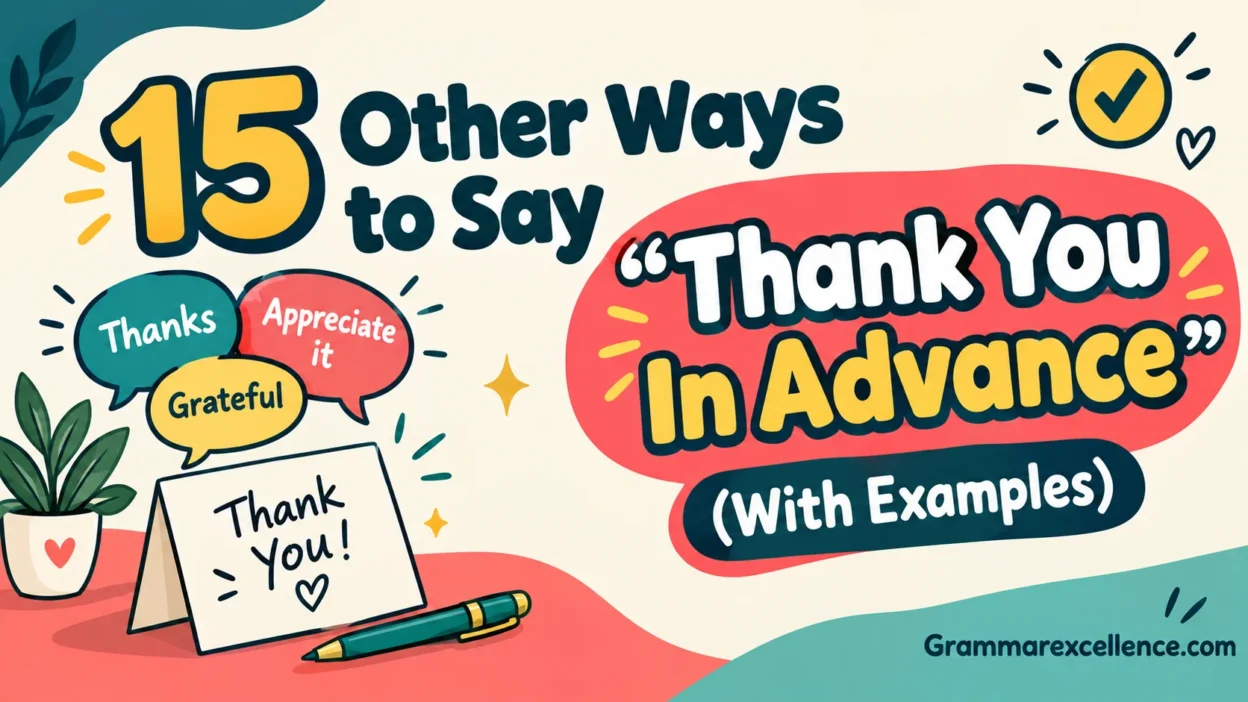
Thank You In Advance is a polite phrase often used when making a request and showing appreciation before someone has provided help. It can make an email, workplace message, or formal request sound respectful and positive. However, the phrase should match the context, relationship, and tone of the conversation. In my experience, it works best when the request is reasonable and the recipient clearly understands what is needed.
Thank You In Advance can show that you value the recipient’s support, time, and willingness to help. Still, some readers may feel the wording sounds slightly presumptuous, especially when the request involves a large favor or requires a decision. In such cases, a softer expression may feel more natural. A simple thank you after explaining the request can also keep the message warm without assuming the outcome.
What Does “Thank You In Advance” Mean?
“Thank you in advance” means that you are expressing gratitude before someone has completed a requested action. It is commonly used when asking someone for help, information, cooperation, or another favor. For example, if you ask a colleague to send you a document and write “Thank you in advance,” you are thanking them ahead of time for the help you hope they will provide. The phrase usually communicates politeness and appreciation, although its tone can vary depending on the request and relationship between the people involved.
Common Situations Where “Thank You In Advance” Is Used
People commonly use “thank you in advance” in emails, workplace communication, school messages, customer requests, and everyday conversations. It is especially common when someone is asking another person to take an action, such as sending information, reviewing a document, answering a question, or providing assistance.
The phrase can also appear in personal communication, although casual speakers may prefer shorter wording such as “Thanks in advance” or “I appreciate your help.” In formal writing, alternatives can sometimes make the request sound more specific and considerate rather than relying on a standard closing phrase.
Is It Professional or Polite to Say “Thank You In Advance”?
Yes, “thank you in advance” is generally polite and can be professional when used appropriately. It shows appreciation for someone’s expected help before they have completed the task. However, the phrase can occasionally sound formulaic or presumptive, especially if the requested action is significant or the recipient has not agreed to help. In those situations, wording such as “I’d appreciate your help” or “Thank you for considering my request” can leave more room for the other person to decide. The best choice depends on the relationship, request, and level of formality.
Advantages and Disadvantages of Saying “Thank You In Advance”
Advantages
The main advantage is that the phrase communicates gratitude and politeness while keeping a request friendly. It is short, familiar, and easy to understand. In professional emails, it can also provide a courteous ending after a straightforward request. When the recipient is already expected to help, the phrase can sound perfectly natural.
Disadvantages
One limitation is that “thank you in advance” can sound repetitive when used in many emails. It may also feel slightly presumptive if the recipient has not agreed to fulfill the request. In sensitive situations, a more specific expression can communicate appreciation without suggesting that assistance is already guaranteed.
Synonyms For “Thank You In Advance”
- Thanks in Advance
- Many Thanks in Advance
- I Appreciate Your Help
- I’d Appreciate It
- Thank You for Your Help
- I’m Grateful for Your Assistance
- Your Help Is Greatly Appreciated
- I Appreciate Your Consideration
- Thanks for Your Time
- I’m Grateful for Your Time
- I Appreciate Your Attention to This
- Thank You for Considering My Request
- I’ll Be Grateful for Your Help
- Much Appreciated
- Thank You Beforehand
1. Thanks in Advance
Meaning
“Thanks in advance” expresses gratitude before someone provides the requested help. It has essentially the same meaning as “thank you in advance,” but it sounds shorter and more conversational.
Definition
Thanks in advance means thank you ahead of time for the help or action I am requesting.
Detailed Explanation
This is one of the closest alternatives to the original phrase. The main difference is its shorter and slightly more casual wording. It works particularly well in emails, messages, and everyday workplace communication. Because it is familiar and direct, it is useful when you want to sound polite without making the request overly formal.
Scenario Examples
Scenario: You need a coworker to send you a file.
Example: “Could you send me the updated report when you have a chance? Thanks in advance.”
Scenario: You are asking a friend for information.
Example: “Can you check whether the shop is open tomorrow? Thanks in advance!”
Best Use
Best for emails, workplace messages, texting, and casual requests where a concise expression is appropriate.
Tone
Tone: Friendly, polite, casual
It sounds appreciative without being overly formal.
2. Many Thanks in Advance
Meaning
“Many thanks in advance” expresses stronger or warmer gratitude before receiving someone’s expected assistance.
Definition
Many thanks in advance means I am very appreciative of the help you are expected to provide.
Detailed Explanation
This expression is similar to “thank you in advance,” but “many thanks” gives the wording a warmer and somewhat more polished feel. It can work well in professional correspondence, particularly when the request is courteous and reasonably modest. It should still be used when you genuinely expect or hope the person will help. The phrase can sound more personal than a simple “thanks.”
Scenario Examples
Scenario: You are requesting information from a professional contact.
Example: “Could you please confirm the meeting time? Many thanks in advance.”
Scenario: You need assistance with a document.
Example: “I’d be grateful if you could review the attached form. Many thanks in advance.”
Best Use
Best for professional emails, polite requests, and correspondence where you want a warm but polished tone.
Tone
Tone: Warm, courteous, professional
The phrase communicates appreciation while retaining a respectful business style.
3. I Appreciate Your Help
Meaning
“I appreciate your help” directly communicates gratitude for someone’s assistance and can be used before or after the person helps.
Definition
I appreciate your help means I value and am grateful for your assistance.
Detailed Explanation
Unlike “thank you in advance,” this expression focuses on the value of the person’s help rather than specifically emphasizing that the thanks are being offered beforehand. It is therefore more flexible and often sounds natural in professional communication. It can be used when help has already been given or when you are asking for help and expect to receive it. The wording feels sincere without being excessively formal.
Scenario Examples
Scenario: You ask a colleague to check a spreadsheet.
Example: “Could you take a quick look at these figures? I appreciate your help.”
Scenario: A friend agrees to help you move.
Example: “I really appreciate your help with everything this weekend.”
Best Use
Best for work emails, personal messages, requests, and conversations where you want flexible wording.
Tone
Tone: Warm, sincere, professional
It sounds appreciative while avoiding the slightly formulaic quality of some standard email closings.
4. I’d Appreciate It
Meaning
“I’d appreciate it” is a concise way to show that you would be grateful if someone completed the requested action.
Definition
I’d appreciate it means I would be grateful if you could do what I am asking.
Detailed Explanation
This expression is useful because it connects gratitude directly to the specific request. It can sound less presumptive than “thank you in advance” because it presents appreciation as something that would follow the person’s assistance. It is common in natural spoken and written English. The exact tone depends on the rest of the sentence, so adding “if you could” often makes the request softer.
Scenario Examples
Scenario: You need a manager to approve a document.
Example: “If you could approve the form by Friday, I’d appreciate it.”
Scenario: You ask a neighbor to collect a package.
Example: “If you’re home this afternoon, I’d really appreciate it if you could take the parcel in.”
Best Use
Best for workplace requests, everyday conversation, emails, and polite favors.
Tone
Tone: Polite, direct, natural
It sounds courteous while clearly communicating what you would like the other person to do.
5. Thank You for Your Help
Meaning
“Thank you for your help” expresses appreciation specifically for someone’s assistance.
Definition
Thank you for your help means I am grateful for the assistance you have provided or are providing.
Detailed Explanation
This expression is especially useful when the person’s assistance is already understood or has already begun. It can also be used immediately after making a request, although it may imply a stronger expectation of help than “I’d appreciate it.” The wording is simple and sincere, making it suitable for many situations. It is often more natural than “thank you in advance” when you want to focus on the person’s contribution.
Scenario Examples
Scenario: A coworker agrees to help with a deadline.
Example: “I’ll send you the files shortly. Thank you for your help.”
Scenario: Someone helps you solve a technical problem.
Example: “That fixed the issue. Thank you for your help!”
Best Use
Best for work emails, customer communication, personal conversations, and follow-up messages.
Tone
Tone: Appreciative, friendly, respectful
It is straightforward and sincere without sounding overly formal.
6. I’m Grateful for Your Assistance
Meaning
“I’m grateful for your assistance” communicates strong appreciation for someone’s help.
Definition
I’m grateful for your assistance and I feel genuinely thankful for the support or help you provide.
Detailed Explanation
This expression is more formal and deliberate than “thank you in advance.” The word “grateful” carries a little more emotional weight than the everyday verb “appreciate.” “Assistance” also has a more formal feel than “help.” It is useful when the request or relationship calls for respectful and polished language.
Scenario Examples
Scenario: You are communicating with a professional who is helping with an application.
Example: “Please let me know if any additional documents are required. I’m grateful for your assistance.”
Scenario: You are writing a formal message to someone who has agreed to help.
Example: “Your guidance has been extremely valuable, and I’m grateful for your assistance.”
Best Use
Best for formal emails, official correspondence, customer communication, and professional situations.
Tone
Tone: Formal, respectful, appreciative
The wording feels more polished and serious than casual alternatives.
7. Your Help Is Greatly Appreciated
Meaning
“Your help is greatly appreciated” tells someone that their assistance is highly valued.
Definition
Your help is greatly appreciated means the assistance you provide is sincerely valued and welcomed.
Detailed Explanation
This expression emphasizes the importance or value of the person’s help. It is more formal than “thanks in advance” and is particularly common in professional or organizational communication. It can be useful when you want to acknowledge that a request requires someone’s time or effort. However, because it is somewhat formal, it may sound excessive for a very small favor between close friends.
Scenario Examples
Scenario: A team needs employees to submit information.
Example: “Please submit your forms by Thursday. Your help is greatly appreciated.”
Scenario: You are asking customers to follow a process.
Example: “Please keep your receipt available during the return process. Your help is greatly appreciated.”
Best Use
Best for professional communication, notices, customer messages, and organizational requests.
Tone
Tone: Professional, courteous, formal
The passive construction gives it a polished and official feel.
8. I Appreciate Your Consideration
Meaning
“I appreciate your consideration” expresses gratitude for someone taking a request, proposal, or situation seriously.
Definition
I appreciate your consideration and I am grateful that you are taking my request or proposal into account.
Detailed Explanation
This is not a direct synonym for every use of “thank you in advance.” It works best when the recipient must review, evaluate, approve, or think about something rather than simply perform a task. It avoids assuming that the person will say yes. That makes it particularly useful for requests where the recipient has discretion.
Scenario Examples
Scenario: You are asking for approval of a schedule change.
Example: “I would be grateful if you could review my request. I appreciate your consideration.”
Scenario: You submit a proposal to an organization.
Example: “Thank you for taking the time to review the proposal. I appreciate your consideration.”
Best Use
Best for formal requests, applications, proposals, workplace communication, and official correspondence.
Tone
Tone: Respectful, formal, considerate
It acknowledges the recipient’s judgment without assuming a particular outcome.
9. Thanks for Your Time
Meaning
“Thanks for your time” expresses appreciation for someone’s attention or time spent helping, listening, meeting, or reviewing something.
Definition
Thanks for your time means I appreciate the time and attention you have given to this matter.
Detailed Explanation
This alternative focuses on the person’s time and attention, not necessarily on completing a specific request. It is especially natural after a meeting, conversation, interview, consultation, or request for feedback. It can sometimes replace “thank you in advance” when the main thing you are asking for is someone’s attention. It is less suitable when you specifically want to thank someone for completing a task.
Scenario Examples
Scenario: You ask a colleague to review a proposal.
Example: “Whenever you have a moment, could you look over the proposal? Thanks for your time.”
Scenario: You finish a professional meeting.
Example: “I enjoyed speaking with you today. Thanks for your time.”
Best Use
Best for meetings, professional emails, interviews, consultations, and requests for feedback.
Tone
Tone: Professional, friendly, appreciative
It is courteous and natural without being overly formal.
10. I’m Grateful for Your Time
Meaning
“I’m grateful for your time” expresses sincere appreciation for the attention or time someone gives you.
Definition
I’m grateful for your time, which means I sincerely value the time you have spent or will spend on this matter.
Detailed Explanation
This expression is warmer and more personal than “thanks for your time.” It can be appropriate when someone’s time is especially valuable or when they have taken significant effort to listen or assist. It does not directly promise gratitude for a particular future action, so it can feel less presumptive. The phrase works particularly well when the communication has a professional but human quality.
Scenario Examples
Scenario: You ask an experienced colleague for advice.
Example: “I know your schedule is busy, so I’m grateful for your time and guidance.”
Scenario: You finish a long consultation.
Example: “Thank you for discussing the options with me. I’m grateful for your time.”
Best Use
Best for professional relationships, consultations, mentoring, interviews, and thoughtful personal communication.
Tone
Tone: Warm, respectful, sincere
It shows appreciation while recognizing that the other person’s time has value.
11. I Appreciate Your Attention to This
Meaning
“I appreciate your attention to this” thanks someone for giving attention and effort to a particular matter.
Definition
I appreciate your attention to this means I value the time and care you give to this specific issue or request.
Detailed Explanation
This phrase is useful when a matter requires someone’s attention, review, or action. It sounds more specific than “thank you in advance” because it identifies the type of contribution being valued. The expression is particularly suitable for professional communication. It can sound somewhat formal in casual conversations, so simpler wording may be preferable with friends.
Scenario Examples
Scenario: You ask an administrator to investigate an issue.
Example: “Please review the attached details when possible. I appreciate your attention to this.”
Scenario: You are following up on a workplace matter.
Example: “I’ve included the relevant information below. I appreciate your attention to this and look forward to your response.”
Best Use
Best for work emails, formal correspondence, customer communication, and issue resolution.
Tone
Tone: Professional, respectful, direct
The phrase emphasizes that the matter deserves careful attention.
12. Thank You for Considering My Request
Meaning
“Thank you for considering my request” expresses gratitude for someone being willing to review or think about what you have asked.
Definition
Thank you for considering my request means I appreciate that you are taking my request into account.
Detailed Explanation
This is particularly useful when the recipient has the choice to accept, reject, or modify your request. Unlike “thank you in advance,” it does not suggest that the requested outcome is already expected. That makes it a tactful option for sensitive or formal requests. It is commonly used when asking for permission, approval, accommodation, or special consideration.
Scenario Examples
Scenario: You request a change to a work schedule.
Example: “I would be grateful if my schedule could be adjusted next week. Thank you for considering my request.”
Scenario: You ask a school administrator to review a special request.
Example: “I have attached the supporting documents. Thank you for considering my request.”
Best Use
Best for formal emails, workplace requests, school communication, applications, and official correspondence.
Tone
Tone: Formal, polite, respectful
It gives the recipient freedom to make the final decision.
13. I’ll Be Grateful for Your Help
Meaning
“I’ll be grateful for your help” communicates that you will sincerely appreciate someone’s assistance.
Definition
I’ll be grateful for your help means I will feel thankful if you provide the assistance I am requesting.
Detailed Explanation
This phrase clearly refers to future assistance, making it a useful alternative to “thank you in advance.” It can sound warmer and more personal because it explains the gratitude that will follow the person’s help. The wording is generally polite but not excessively formal. It works best when you are making a genuine request rather than giving an instruction.
Scenario Examples
Scenario: You ask a friend to help you prepare for an event.
Example: “If you can help me organize the invitations, I’ll be grateful for your help.”
Scenario: You ask a coworker for guidance.
Example: “If you could point me toward the correct form, I’ll be grateful for your help.”
Best Use
Best for personal requests, workplace messages, friendly communication, and polite favors.
Tone
Tone: Warm, humble, appreciative
It communicates gratitude while making the future nature of the help clear.
14. Much Appreciated
Meaning
“Much appreciated” is a short expression used to show that someone’s help, effort, or action is highly valued.
Definition
Much appreciated means your help or effort is sincerely valued and appreciated.
Detailed Explanation
This is a compact expression that can be used after a request or after someone has helped. It is particularly common in informal and workplace communication, especially in short messages. Because it is brief, it can sound less formal than a complete sentence such as “I appreciate your assistance.” It is best when the surrounding message already makes the request clear.
Scenario Examples
Scenario: You ask a coworker to send a document.
Example: “Could you forward me the final version when you get a chance? Much appreciated.”
Scenario: Someone agrees to cover a small task.
Example: “Thanks for taking care of that—much appreciated.”
Best Use
Best for work chats, short emails, text messages, and everyday requests.
Tone
Tone: Casual, concise, appreciative
Its short form makes it efficient and friendly.
15. Thank You Beforehand
Meaning
“Thank you beforehand” expresses gratitude before a person provides the requested assistance.
Definition
Thank you beforehand means thank you before the expected help or action takes place.
Detailed Explanation
This phrase conveys the same basic idea as “thank you in advance,” but it is less common and less natural in many everyday situations. Native speakers generally prefer “thank you in advance” or “thanks in advance.” “Beforehand” is grammatically understandable, but the expression can feel slightly unusual when used as a standard email closing. It can still be understood clearly when the meaning of the request is obvious.
Scenario Examples
Scenario: You are making a simple request in a personal message.
Example: “Could you bring the documents with you tomorrow? Thank you beforehand.”
Scenario: You are asking someone to provide information.
Example: “Please let me know if you find the details. Thank you beforehand.”
Best Use
Best when you specifically want to express advance gratitude, although “thank you in advance” is usually the more natural choice.
Tone
Tone: Polite, somewhat formal, less idiomatic
The meaning is clear, but native speakers usually choose more conventional alternatives.
FAQs
Q1. What is another way to say “Thank You In Advance”?
Useful alternatives include “Thanks in advance,” “I appreciate your help,” “I’d appreciate it,” and “I’ll be grateful for your help.” The best choice depends on whether you want to sound casual, professional, warm, or formal.
Q2. What does “Thank You In Advance” mean?
“Thank you in advance” means that you are expressing gratitude before someone provides the help or completes the action you are requesting. It is commonly used in polite requests and professional emails.
Q3. Is “Thank You In Advance” professional?
Yes. “Thank you in advance” can be professional and polite, particularly for straightforward requests. However, alternatives such as “I appreciate your consideration” may be better when the recipient needs to make a decision rather than simply complete a task.
Q4. What is a more polite way to say “Thank You In Advance”?
For a more considerate tone, you can use “I’d appreciate your help,” “Thank you for considering my request,” or “I appreciate your consideration.” These expressions can sound less presumptive because they do not automatically assume that the recipient will fulfill the request.
Q5. Which alternative works best in formal communication?
For formal communication, “Thank you for considering my request,” “I appreciate your consideration,” and “I’m grateful for your assistance” are useful choices. Select the expression according to whether you are requesting a decision, asking for assistance, or acknowledging someone’s time and effort.
Conclusion
Thank You In Advance can make a request sound polite, respectful, and appreciative when used in the right context. It shows gratitude for someone’s expected support, time, or help. However, the phrase may sometimes sound presumptuous, especially for larger favors. Choosing natural wording that leaves room for a response can create better communication and help the reader feel valued rather than pressured.