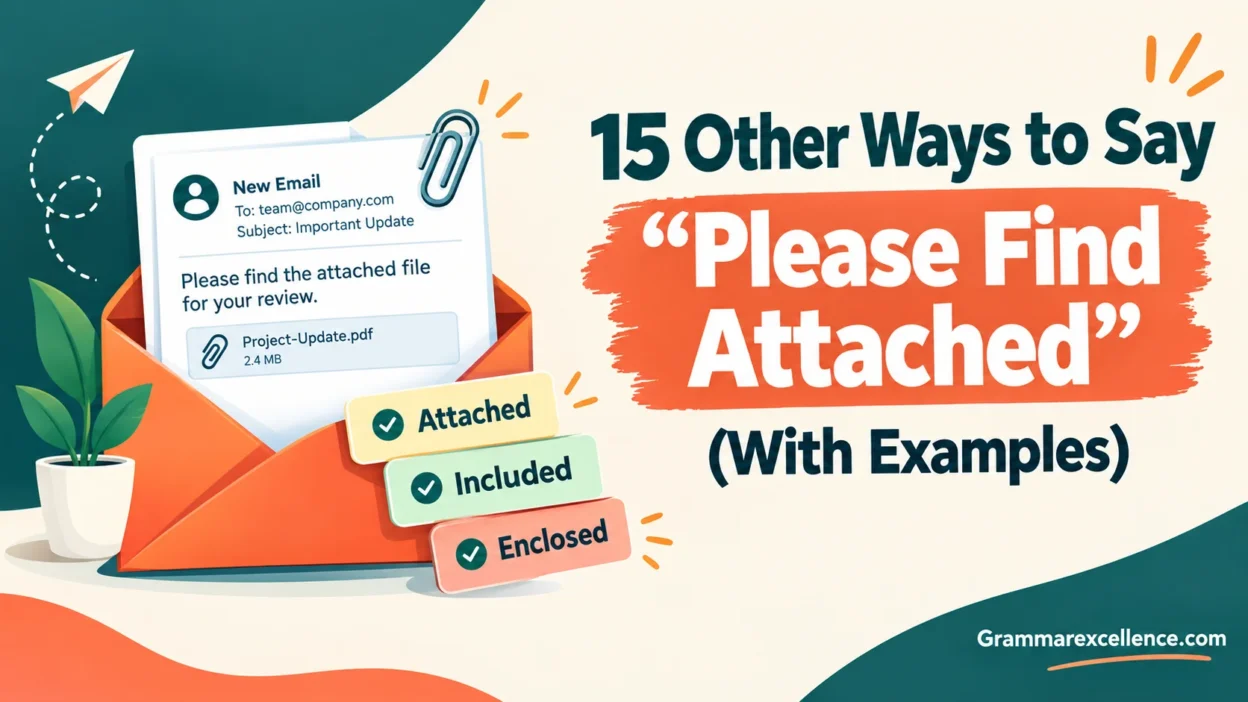
Please Find Attached is a useful phrase for professional emails when you want to point the recipient toward a file or document included with your message. However, modern communication often works better with simple wording, a clear tone, and natural language. Instead of using the same expression in every email, you can choose alternatives based on your audience, purpose, and the action you want the recipient to take. For example, when sending a job application email with a resume, briefly naming the attached file can make your message more direct and easier to understand.
A practical approach is to identify the document, explain its purpose, and mention the required next action. This works well when sharing reports, proposals, or important documents that need review. In my experience, professionals, students, and writers can make their emails more effective by using human alternatives that improve readability, clarity, and natural flow. Simple phrases can also add creativity and help you connect with the recipient without making the message unnecessarily formal.
Although Please Find Attached is technically correct and grammatically correct, it may sometimes sound robotic or outdated, especially in everyday business email. Expressions such as Attached, please find can have the same traditional feel, so a useful best practice is to name the file, explain why it matters, and state what should happen next. Modern alternatives, real examples, style tips, and a step-by-step breakdown can help you write more fresh, engaging, and impactful attachment emails while reducing unnecessary formality.
What Does “Please Find Attached” Mean?
“Please find attached” is an email phrase used to tell someone that a file or document is included with the message. It usually appears when sending reports, applications, invoices, photographs, forms, or other attachments. The phrase essentially means, “The requested or relevant document is attached to this email.” It is widely understood in professional communication, although modern business English often favors more direct wording such as “I’ve attached” or “Attached is.”
Common Situations Where “Please Find Attached” Is Used
People commonly use “Please find attached” in work emails, business correspondence, applications, customer communication, and formal requests. For example, someone might use it when sending a completed form to an office, a report to a manager, or an invoice to a customer. It is less common in casual texting because the phrase has a distinctly email-oriented and professional feel.
An alternative may be preferable when you want your message to sound more conversational and direct. Instead of simply pointing out an attachment, you can tell the recipient exactly what you have attached and why it matters.
Is It Professional or Polite to Say “Please Find Attached”?
Yes. “Please find attached” is polite and professional, particularly in formal emails. It communicates the attachment clearly and maintains a respectful tone. However, it can sound somewhat formal or traditional, especially in relaxed workplaces. In modern business communication, “I’ve attached…” is often more natural because it uses straightforward language without changing the meaning.
Advantages and Disadvantages of Saying “Please Find Attached”
Advantages
The main advantage is clarity. The recipient immediately knows that an attachment accompanies the email. The wording is also polite, familiar, and suitable for formal correspondence. It works especially well when communicating with organizations, officials, clients, or people you do not know personally.
Disadvantages
The phrase can feel overly formal or formulaic when used repeatedly. It also focuses on asking the recipient to “find” the attachment rather than simply stating that you have included it. In a friendly workplace or everyday professional email, a more direct expression can sound more natural and personal.
Synonyms For “Please Find Attached”
- I’ve attached
- Attached is
- I’ve included
- Here is the
- I’m attaching
- Please see the attached
- The attached document contains
- For your reference, I’ve attached
- I’m pleased to attach
- You’ll find attached
- Enclosed is
- I’ve provided
- I’m sharing
- The requested document is attached
- I’ve included the requested file
1. I’ve attached
Meaning
“I’ve attached” directly tells the recipient that you have included a file with the email. It is one of the most natural and versatile alternatives to “Please find attached.”
Definition
I’ve attached means “I have included this file with my email.”
Detailed Explanation
This wording is more direct and conversational than “Please find attached.” It works particularly well in modern workplace emails because it clearly identifies your action. You can follow it with the name or purpose of the file. The expression is professional without sounding unnecessarily formal.
Scenario Examples
Scenario: Sending a report to your manager.
Example: “I’ve attached the monthly sales report for your review.”
Scenario: Sending a completed form.
Example: “I’ve attached the completed application form.”
Best Use
Best for professional emails, workplace communication, clients, and everyday business correspondence.
Tone
Tone: Professional, clear, natural.
It sounds respectful while avoiding overly formal language.
2. Attached is
Meaning
“Attached is” introduces the document that accompanies your email. It is concise and immediately tells the reader what they should expect to see.
Definition
Attached is means “The following document or file is included with this email.”
Detailed Explanation
This phrase is shorter and more direct than “Please find attached.” It works well when you want to keep an email concise. Because it is slightly formal, it can fit both traditional business communication and modern professional writing. The sentence becomes especially useful when the attachment has a specific name or purpose.
Scenario Examples
Scenario: Sending a proposal.
Example: “Attached is our revised project proposal.”
Scenario: Sending a meeting document.
Example: “Attached is the agenda for tomorrow’s meeting.”
Best Use
Best for business emails, formal correspondence, reports, proposals, and official documents.
Tone
Tone: Concise, professional, formal.
Its brevity makes the message efficient and easy to understand.
3. I’ve included
Meaning
“I’ve included” tells the recipient that you have added a document or file to the email.
Definition
I’ve included means “I have added this item for you to review or use.”
Detailed Explanation
This expression feels slightly warmer and more conversational than “Please find attached.” It can refer to an attachment, but it may also work when information is included directly in an email. That broader meaning makes it useful when the distinction between an attachment and included material is not important. It is a friendly choice for professional communication.
Scenario Examples
Scenario: Sending supporting information.
Example: “I’ve included the supporting documents for your reference.”
Scenario: Sending information to a colleague.
Example: “I’ve included the updated figures in the attached report.”
Best Use
Best for work emails, colleagues, clients, and helpful follow-up messages.
Tone
Tone: Friendly, professional, helpful.
It emphasizes that you have provided something useful rather than simply pointing toward an attachment.
4. Here is the
Meaning
“Here is the” introduces a specific document or file that you are sending.
Definition
Here it means “I am providing the requested or relevant document now.”
Detailed Explanation
This is a simple and natural expression that works particularly well when the recipient already knows what document you are discussing. It sounds less formal than “Please find attached.” The wording also creates a direct connection between your email and the material you are providing. It is especially useful for routine exchanges.
Scenario Examples
Scenario: Sending a requested invoice.
Example: “Here is the invoice you requested.”
Scenario: Sending a revised document.
Example: “Here is the updated version of the contract.”
Best Use
Best for routine professional emails, customer communication, colleagues, and informal business exchanges.
Tone
Tone: Direct, friendly, straightforward.
It sounds natural because it resembles ordinary spoken English.
5. I’m attaching
Meaning
“I’m attaching” tells the recipient what you are including with the email.
Definition
I’m attaching means “I am adding this file to the email.”
Detailed Explanation
This expression focuses on the action of attaching rather than asking the reader to locate something. It is particularly useful when you want to mention the attachment naturally within a longer sentence. The wording is less formal than “Please find attached” while remaining appropriate for professional communication. It can also sound more personal because the sender is clearly identified as the person taking the action.
Scenario Examples
Scenario: Sending a photograph.
Example: “I’m attaching a copy of the signed receipt.”
Scenario: Providing supporting paperwork.
Example: “I’m attaching the documents you requested yesterday.”
Best Use
Best for professional emails, customer support, colleagues, and direct communication.
Tone
Tone: Natural, professional, conversational.
It is a good middle ground between formal and casual language.
6. Please see the attached
Meaning
“Please see the attached” politely directs the recipient to a document or file included with the email.
Definition
Please see the attached means “Please look at the document or file included with this message.”
Detailed Explanation
This expression is close in meaning to “Please find attached”, but it emphasizes reviewing or looking at the attachment. It is useful when you expect the recipient to read, check, or respond to the material. The wording remains polite and professional. However, it is usually clearer to identify the attachment, such as “Please see the attached report.”
Scenario Examples
Scenario: Asking a manager to review a report.
Example: “Please see the attached report and let me know if you have any comments.”
Scenario: Sending a quotation to a customer.
Example: “Please see the attached quotation for the requested services.”
Best Use
Best for formal emails, reports, quotations, business documents, and review requests.
Tone
Tone: Polite, professional, direct.
The word “please” keeps the request courteous.
7. The attached document contains
Meaning
“The attached document contains” tells the reader what information they will find inside the attachment.
Definition
The attached document means “The information described here is provided in the attached document.”
Detailed Explanation
This is more informative than simply saying “Please find attached.” Instead of focusing on the existence of the attachment, it tells the reader what it contains. That can help the recipient understand why the file matters before opening it. It is particularly useful for longer or important documents.
Scenario Examples
Scenario: Sending financial information.
Example: “The attached document contains the updated financial figures.”
Scenario: Providing project details.
Example: “The attached document contains the specifications for the new project.”
Best Use
Best for reports, technical documents, business records, and formal communication.
Tone
Tone: Informative, professional, precise.
It provides useful context rather than merely announcing the attachment.
8. For your reference, I’ve attached
Meaning
“For your reference, I’ve attached” explains that the attachment is being provided so the recipient can consult it when needed.
Definition
It means “I have attached this document so you can refer to it for information.”
Detailed Explanation
This expression is useful when the recipient does not necessarily need to take immediate action. The phrase “for your reference” signals that the document is being supplied as background information or a useful record. It sounds professional and considerate. Compared with “Please find attached,” it gives the attachment a clearer purpose.
Scenario Examples
Scenario: Sending previous meeting notes.
Example: “For your reference, I’ve attached the notes from our last meeting.”
Scenario: Providing background information to a colleague.
Example: “For your reference, I’ve attached the previous project summary.”
Best Use
Best for professional emails, background documents, records, and informational communication.
Tone
Tone: Professional, helpful, considerate.
It makes the purpose of the attachment clear without demanding action.
9. I’m pleased to attach
Meaning
“I’m pleased to attach” introduces a document in a positive and somewhat formal way.
Definition
I’m pleased to attach “I am happy to provide this document with my email.”
Detailed Explanation
This wording adds a small amount of positive emotion to the message. It can work well when the document represents an important development, completed work, approval, or formal submission. It is more formal than “I’ve attached,” so it may feel excessive for routine files. Choose it when the attachment itself is something meaningful or positive.
Scenario Examples
Scenario: Sending an approved proposal.
Example: “I’m pleased to attach the approved proposal for your records.”
Scenario: Sending a completed project report.
Example: “I’m pleased to attach the final report for your review.”
Best Use
Best for formal business correspondence, announcements, submissions, and positive professional updates.
Tone
Tone: Formal, positive, courteous.
The phrase “pleased” adds warmth while maintaining professionalism.
10. You’ll find attached
Meaning
“You’ll find attached” tells the recipient that a particular document is included with the email.
Definition
You’ll find attached means “The document mentioned is included with this message.”
Detailed Explanation
This is a traditional professional expression that is very close to “Please find attached.” It sounds polished but can be slightly formal in casual workplace conversations. It works particularly well when introducing an important document. The phrase is best used when the recipient is expected to locate or review the attachment.
Scenario Examples
Scenario: Sending an official letter.
Example: “You’ll find attached the letter confirming your appointment.”
Scenario: Sending a business report.
Example: “You’ll find attached the quarterly performance report.”
Best Use
Best for formal emails, official communication, reports, and business correspondence.
Tone
Tone: Formal, polished, professional.
It has a traditional business-writing style.
11. Enclosed is
Meaning
“Enclosed is” means that a document is included with the communication.
Definition
Enclosed means “The document mentioned is provided along with this correspondence.”
Detailed Explanation
This expression is strongly associated with formal written communication. It is more common with letters and physical correspondence than ordinary modern emails, although it can occasionally appear in formal business writing. For an email, “attached is” will usually sound more natural. Use “enclosed” when the communication has a particularly traditional or official character.
Scenario Examples
Scenario: Formal correspondence.
Example: “Enclosed is the completed registration form.”
Scenario: Sending official paperwork.
Example: “Enclosed is a copy of the requested certificate.”
Best Use
Best for formal letters, official correspondence, and traditional business writing.
Tone
Tone: Very formal, traditional, official.
Its formality makes it less suitable for casual email exchanges.
12. I’ve provided
Meaning
“I’ve provided” emphasizes that you have supplied information or a document for the recipient.
Definition
I’ve provided means “I have supplied the requested information or material.”
Detailed Explanation
This wording focuses on providing information rather than the technical act of attaching a file. That makes it useful when the attachment is part of a broader response. It sounds professional without being stiff. Depending on the sentence, it can work for both attachments and information supplied elsewhere in the message.
Scenario Examples
Scenario: Responding to a customer’s request.
Example: “I’ve provided the requested documents for your review.”
Scenario: Sending project information.
Example: “I’ve provided the specifications in the attached file.”
Best Use
Best for customer communication, professional emails, requests, and formal responses.
Tone
Tone: Professional, helpful, neutral.
It emphasizes fulfilling the recipient’s request.
13. I’m sharing
Meaning
“I’m sharing” tells the recipient that you are making a file, document, or piece of information available to them.
Definition
I’m sharing means “I am providing this material for you to access or review.”
Detailed Explanation
This is a modern and conversational alternative. It works especially well when sending files through digital platforms, cloud storage, or workplace collaboration tools. Unlike “Please find attached,” it does not necessarily imply a traditional email attachment. It is therefore useful when the material is shared through a link or digital workspace.
Scenario Examples
Scenario: Sharing a presentation with coworkers.
Example: “I’m sharing the presentation from today’s meeting for everyone’s reference.”
Scenario: Sending a document through a workplace platform.
Example: “I’m sharing the updated guidelines with the team.”
Best Use
Best for team communication, digital collaboration, workplace messages, and friendly professional emails.
Tone
Tone: Modern, friendly, collaborative.
It feels less formal and more natural in digital communication.
14. The requested document is attached
Meaning
“The requested document is attached” directly confirms that the file someone asked for has been included.
Definition
It means “The document you asked me to provide is included with this message.”
Detailed Explanation
This wording is especially useful when responding to a specific request. It removes uncertainty because the recipient immediately knows that the requested document is present. The phrase is more direct and factual than “Please find attached.” It can sound slightly formal, but it is highly suitable for official or customer-facing communication.
Scenario Examples
Scenario: Responding to a document request.
Example: “The requested document is attached for your review.”
Scenario: Responding to an office request.
Example: “The requested document is attached to this email.”
Best Use
Best for customer service, official correspondence, administrative communication, and document requests.
Tone
Tone: Formal, clear, factual.
It works well when accuracy and clarity are more important than conversational warmth.
15. I’ve included the requested file
Meaning
“I’ve included the requested file” tells the recipient that the specific file they asked for has been provided.
Definition
It means “I have added the file you requested to this email.”
Detailed Explanation
This expression combines the friendly quality of “I’ve included” with the clarity of identifying the file as requested. It is particularly useful when replying to someone who previously asked for a document. The wording feels natural in modern professional communication. It also makes the purpose of the attachment immediately clear.
Scenario Examples
Scenario: Sending a form requested by a colleague.
Example: “I’ve included the requested file for you to complete.”
Scenario: Responding to a customer’s document request.
Example: “I’ve included the requested file with the information you asked for.”
Best Use
Best for professional emails, customer communication, workplace requests, and follow-ups.
Tone
Tone: Helpful, professional, friendly.
It sounds cooperative without becoming overly formal.
FAQs
Q1. What is another way to say “Please Find Attached”?
A natural modern alternative is “I’ve attached”. Other options include “Attached is,” “I’ve included,” “Please see the attached,” and “The requested document is attached.” The best choice depends on the formality and purpose of the email.
Q2. What does “Please Find Attached” mean?
“Please find attached” means that a document or file is included with the email. It is commonly used in professional and formal correspondence to direct the recipient toward the attachment.
Q3. Is “Please Find Attached” professional?
Yes. “Please find attached” is professional and polite, but it has a somewhat traditional tone. In many modern workplaces, “I’ve attached” may sound more natural and direct.
Q4. What is a more polite way to say “Please Find Attached”?
If you want to sound especially courteous, you can use “For your reference, I’ve attached…” or “Please see the attached…” These expressions can be useful when you want to explain the purpose of the document or invite the recipient to review it.
Q5. Which alternative works best in formal communication?
For formal communication, “Attached is,” “Please see the attached,” and “The requested document is attached” are strong choices. For very traditional correspondence, “Enclosed is” may also work, although it is generally more natural for physical letters than everyday emails.
Conclusion
Please Find Attached is still correct, but modern emails can sound more natural, clear, and professional when you choose wording that fits the audience and purpose. By naming the file, explaining its purpose, and stating the next action, you make attachments easier to understand. Simple alternatives can improve readability, strengthen communication, and create a more approachable tone without unnecessary formality.