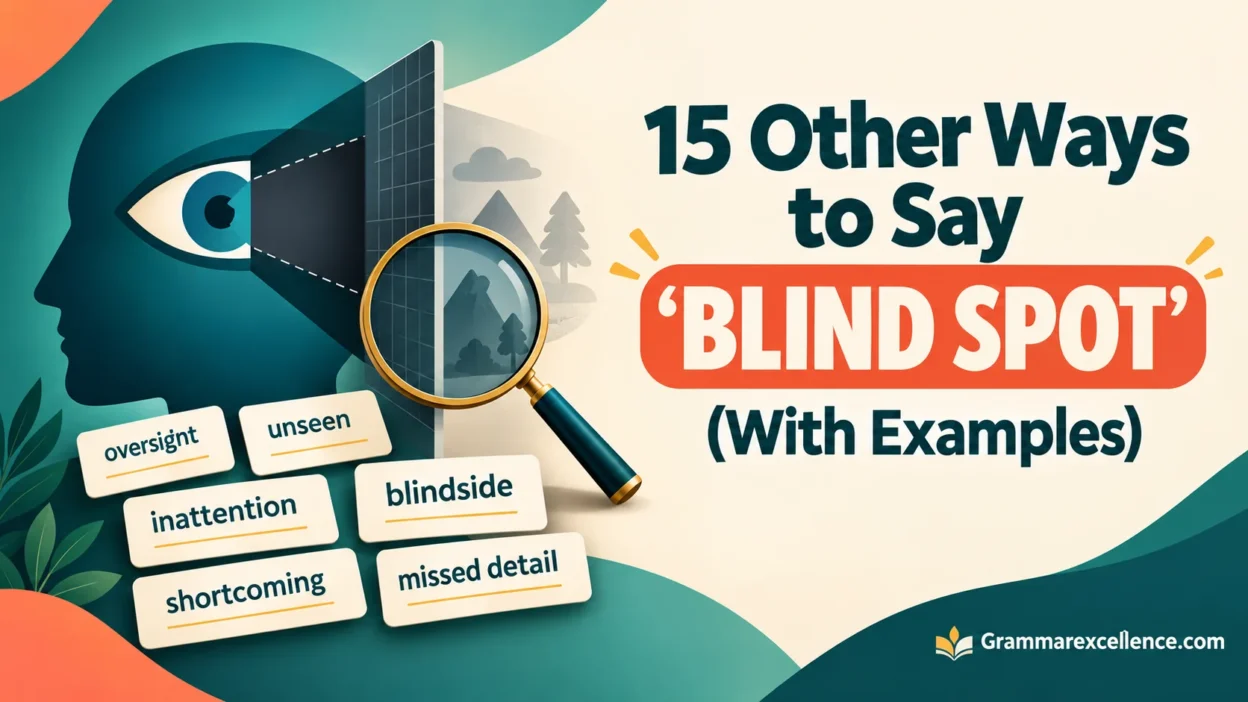
Blind Spot can describe something we fail to notice, understand, or recognize, especially when it involves a weakness or overlooked area. It may affect our decisions, communication, and personal growth without us realizing it. In my experience, a missed perspective during a team meeting, an unnoticed weakness in a project, or a behavior that affects relationships can reveal an important blind spot.
A blind spot can also have a literal connection with vision. A scotoma is a small area where no vision is present, and one naturally occurs because the retina has a gap where the optic nerve carries visual information to the brain. The brain normally ignores this missing information and fills in the view, so we are rarely aware of it.
In professional environments, educational settings, and everyday conversations, identifying a blind spot can help people understand why certain challenges continue despite their best efforts. The phrase is also common in coaching, leadership development, and workplace feedback, where choosing a precise, polite, professional, or conversational expression can make an idea clearer and more natural.
What Does “Blind Spot” Mean?
A blind spot is an area that someone cannot easily see, recognize, or understand. Literally, it can refer to an area outside a person’s normal field of vision, such as the space a driver cannot see directly through the mirrors. Figuratively, a blind spot is a weakness, gap in awareness, or overlooked issue that a person does not recognize about themselves or a situation. For example, someone may be highly skilled at their job but have a blind spot when it comes to accepting criticism. The phrase often suggests that the person is unaware of something important rather than deliberately ignoring it.
Common Situations Where “Blind Spot” Is Used
People use blind spot in both everyday and professional communication. In personal conversations, it can describe an unrecognized weakness or something a friend has failed to notice. At work, managers may discuss blind spots in decision-making, leadership, communication, or planning. Teachers and students can also use the phrase when talking about gaps in understanding. In writing and social media, blind spot is useful when explaining why someone may overlook an important issue. Because it can sound somewhat direct, alternatives may be helpful when you want to make the message softer, clearer, or more specific.
Is It Professional or Polite to Say “Blind Spot”?
Yes, blind spot can be professional and polite when it is used thoughtfully. It is common in discussions about leadership, personal development, business decisions, risk, and performance. However, saying that someone “has a blind spot” can sometimes feel critical or personal, particularly if the listener is sensitive to criticism. In a formal setting, a phrase such as area for improvement, knowledge gap, or area of limited awareness may sound more constructive. The best choice depends on whether you want to emphasize a weakness, an overlooked detail, or simply a lack of awareness.
Advantages and Disadvantages of Saying “Blind Spot”
Advantages
The main advantage of blind spot is that it communicates a complex idea in a short and familiar expression. It can clearly suggest that someone is missing something without realizing it. The phrase also works well in professional conversations, personal discussions, coaching, and reflective writing. Its figurative meaning is easy to understand because it creates a strong image of something that remains outside a person’s view.
Disadvantages
The phrase can sometimes sound too direct when you are discussing another person’s weakness. It may also be too broad because a blind spot could refer to a lack of knowledge, an overlooked detail, a personal weakness, or an unnoticed risk. In highly formal writing, a more precise term may communicate the exact issue better. Choosing a specific alternative can make your wording more constructive and less judgmental.
Synonyms For “Blind Spot”
- Oversight
- Gap in Awareness
- Area of Unawareness
- Weak Spot
- Vulnerability
- Shortcoming
- Limitation
- Overlooked Area
- Knowledge Gap
- Lack of Awareness
- Point of Weakness
- Neglected Area
- Missed Detail
- Perceptual Gap
- Area for Improvement
1. Oversight
Meaning
An oversight is something important that a person fails to notice, consider, or deal with. It is closely related to the figurative meaning of blind spot when the problem involves something being accidentally missed.
Definition
An oversight is an unintentional failure to notice or consider something.
Detailed Explanation
Unlike blind spot, oversight usually focuses on a specific mistake or omission rather than a lasting weakness in someone’s thinking. It is especially useful when something was accidentally left out of a plan, document, decision, or task. The word can sound more neutral and professional than blind spot. Use it when you want to describe what was missed without strongly criticizing the person.
Scenario Examples
Scenario: A manager forgets to include an important department in a project plan.
Example: “Leaving the design team out of the meeting was an unfortunate oversight.”
Scenario: You forget to attach a file to an email.
Example: “I apologize for the oversight. I’ve attached the document now.”
Best Use
Best for professional communication, emails, reports, mistakes, planning, and formal discussions.
Tone
Tone: Professional, neutral, accountable.
It focuses on what was missed rather than labeling someone as weak or unaware.
2. Gap in Awareness
Meaning
A gap in awareness describes something a person does not fully recognize, understand, or know. It is a gentle alternative when blind spot refers to limited understanding.
Definition
A gap in awareness is a lack of recognition or understanding about a particular issue.
Detailed Explanation
This expression is more explanatory than blind spot. It does not necessarily suggest that someone has a permanent weakness; instead, it points to missing awareness in a particular area. It works especially well when discussing learning, communication, workplace behavior, or social issues. The wording can feel more constructive because it leaves room for improvement.
Scenario Examples
Scenario: An employee does not realize how their emails sound to others.
Example: “There seems to be a gap in awareness about how the messages are being received.”
Scenario: A student does not understand an important part of a topic.
Example: “The teacher identified a gap in awareness that needed more attention.”
Best Use
Best for education, workplace feedback, coaching, training, and constructive conversations.
Tone
Tone: Gentle, professional, constructive.
It describes missing awareness without sounding strongly critical.
3. Area of Unawareness
Meaning
An area of unawareness is a subject or part of a situation that someone does not recognize or understand fully.
Definition
An area of unawareness is a specific part of knowledge or experience that a person has not recognized.
Detailed Explanation
This phrase is more formal and precise than blind spot. It is useful when discussing self-awareness, professional development, research, or personal reflection. Unlike oversight, it does not necessarily mean someone made a single mistake. It suggests that the person may simply not recognize an issue or limitation yet.
Scenario Examples
Scenario: A team leader does not realize that they interrupt colleagues.
Example: “Interrupting others may be an area of unawareness for the manager.”
Scenario: Someone discovers a weakness through feedback.
Example: “The feedback helped her identify an area of unawareness in her communication style.”
Best Use
Best for professional development, coaching, academic writing, and reflective discussions.
Tone
Tone: Formal, thoughtful, analytical.
The expression sounds less personal and more objective than blind spot.
4. Weak Spot
Meaning
A weak spot is a part of something that is less strong, effective, or reliable than the rest.
Definition
A weak spot is a particular weakness or vulnerable area.
Detailed Explanation
Weak spot is more direct and informal than blind spot. It usually emphasizes an actual weakness rather than a failure to recognize something. It can describe a person, plan, system, strategy, or organization. Because it is straightforward, it works well when the main issue is strength or performance rather than awareness.
Scenario Examples
Scenario: A football team struggles with defending corners.
Example: “Defending set pieces has become the team’s weak spot.”
Scenario: A student is strong in mathematics but struggles with writing.
Example: “Essay writing is probably his weak spot.”
Best Use
Best for casual conversation, sports, performance discussions, personal development, and everyday English.
Tone
Tone: Casual, direct, practical.
It clearly identifies weakness but can sound more blunt than blind spot.
5. Vulnerability
Meaning
A vulnerability is a weakness or exposed area that could make a person, system, or situation more likely to experience harm or difficulty.
Definition
A vulnerability is a weak point that can be exposed to risk or harm.
Detailed Explanation
Vulnerability differs from blind spot because it emphasizes risk and exposure, not necessarily a lack of awareness. It is particularly useful in business, technology, security, relationships, and risk management. If the issue involves something that could cause damage when exploited, vulnerability is often more precise. It can also describe an emotional sensitivity in personal communication.
Scenario Examples
Scenario: A company discovers a weakness in its computer system.
Example: “The outdated software created a serious vulnerability.”
Scenario: A business relies too heavily on one supplier.
Example: “Depending on a single supplier is a major vulnerability.”
Best Use
Best for risk assessment, business, technology, security, relationships, and formal analysis.
Tone
Tone: Serious, analytical, professional.
It emphasizes potential risk rather than simple lack of awareness.
6. Shortcoming
Meaning
A shortcoming is a weakness, fault, or limitation that prevents someone or something from being as effective as it could be.
Definition
A shortcoming is a weakness or deficiency in performance, ability, or quality.
Detailed Explanation
Shortcoming is stronger than blind spot when the issue is an actual deficiency rather than something unnoticed. It is often used to discuss a person’s skills, a product’s features, or a system’s performance. The word can sound critical, so it should be used carefully when giving personal feedback. It is useful when the problem needs to be clearly identified.
Scenario Examples
Scenario: A report contains excellent research but weak organization.
Example: “The report’s main shortcoming is its unclear structure.”
Scenario: Someone asks for honest feedback about their presentation.
Example: “One shortcoming is that the main points were not clearly explained.”
Best Use
Best for feedback, reviews, evaluations, reports, academic work, and professional discussions.
Tone
Tone: Direct, evaluative, professional.
It identifies a genuine deficiency rather than simply something unnoticed.
7. Limitation
Meaning
A limitation is something that restricts what a person, method, system, or situation can do.
Definition
A limitation is a boundary, restriction, or weakness that reduces effectiveness or capability.
Detailed Explanation
Limitation is broader and usually softer than shortcoming. It does not always suggest that someone is at fault. A limitation may result from circumstances, resources, knowledge, skills, or design. It can therefore be a good alternative when you want to discuss a weakness in a neutral and respectful way.
Scenario Examples
Scenario: A research project has a small sample size.
Example: “The small sample size is an important limitation of the study.”
Scenario: Someone struggles to manage several projects at once.
Example: “Time management is a current limitation for the team.”
Best Use
Best for formal writing, research, workplace communication, evaluations, and thoughtful feedback.
Tone
Tone: Neutral, formal, measured.
It sounds less personal because it describes a boundary rather than assigning blame.
8. Overlooked Area
Meaning
An overlooked area is a part of a subject, plan, or situation that has not received enough attention.
Definition
An overlooked area is a particular issue or subject that has been unintentionally neglected.
Detailed Explanation
This expression is especially useful when blind spot refers to something that people simply failed to consider. It does not necessarily imply a weakness in a person’s character or ability. The phrase is flexible and can be used for projects, discussions, policies, studies, and everyday situations. It is often a good choice when you want to sound diplomatic.
Scenario Examples
Scenario: A business plan focuses on sales but ignores customer support.
Example: “Customer retention was an overlooked area in the original plan.”
Scenario: A school project ignores accessibility.
Example: “Accessibility became an overlooked area during the initial planning.”
Best Use
Best for business, education, planning, reports, meetings, and constructive criticism.
Tone
Tone: Diplomatic, neutral, professional.
It draws attention to what was missed without directly blaming anyone.
9. Knowledge Gap
Meaning
A knowledge gap is an area where someone or a group does not have enough information or understanding.
Definition
A knowledge gap is a difference between what is known and what needs to be known.
Detailed Explanation
Knowledge gap is more specific than blind spot because it focuses on information or understanding. It is ideal when the problem can be solved through learning, research, training, or education. Unlike an oversight, a knowledge gap may exist even when someone has carefully considered the issue. It is therefore useful for identifying areas where additional knowledge is needed.
Scenario Examples
Scenario: A new employee does not understand a company procedure.
Example: “The training revealed a knowledge gap about the reporting process.”
Scenario: Researchers need more information about a topic.
Example: “There is still a knowledge gap regarding the long-term effects.”
Best Use
Best for education, research, training, professional development, and technical communication.
Tone
Tone: Academic, neutral, informative.
It focuses on missing knowledge rather than personal failure.
10. Lack of Awareness
Meaning
A lack of awareness means that someone does not know about, recognize, or understand something important.
Definition
Lack of awareness is a failure to recognize or understand a particular issue or situation.
Detailed Explanation
This expression is one of the clearest alternatives when blind spot specifically means not realizing something. It is more literal and less metaphorical than the original phrase. Depending on the situation, it can sound neutral or somewhat critical. Adding a specific subject makes it more useful, such as “a lack of awareness of customer needs.”
Scenario Examples
Scenario: Employees do not understand a new safety procedure.
Example: “The problem appears to come from a lack of awareness of the updated rules.”
Scenario: Someone does not notice how their behavior affects others.
Example: “His reaction may reflect a lack of awareness of how others feel.”
Best Use
Best for formal communication, workplace discussions, education, public information, and personal conversations.
Tone
Tone: Neutral, direct, sometimes critical.
Its tone depends heavily on whether the wording is used to explain a problem or criticize someone.
11. Point of Weakness
Meaning
A point of weakness is a particular part of a person, plan, system, or strategy that is less strong than other parts.
Definition
A point of weakness is a specific feature or area where strength or effectiveness is limited.
Detailed Explanation
This expression is more explicit than blind spot because it clearly identifies weakness. It works well when analyzing performance, strategies, organizations, or arguments. It does not necessarily imply that the person is unaware of the issue. Use it when the main goal is to identify where something could be improved or challenged.
Scenario Examples
Scenario: A business strategy depends on one market.
Example: “Reliance on one market is a clear point of weakness.”
Scenario: A student reviews an essay before submitting it.
Example: “The introduction is a point of weakness because the main argument is unclear.”
Best Use
Best for analysis, strategy, education, performance reviews, and structured feedback.
Tone
Tone: Analytical, direct, objective.
It clearly identifies weakness without necessarily making a personal judgment.
12. Neglected Area
Meaning
A neglected area is something that has not received enough attention, care, or consideration.
Definition
A neglected area is a particular subject or responsibility that has been insufficiently attended to.
Detailed Explanation
Neglected area can be stronger than overlooked area because neglected may suggest that something has been ignored for a period of time. However, it does not always imply deliberate neglect. The expression works particularly well when discussing projects, responsibilities, services, or long-term problems. Choose it when the lack of attention is more significant than a single missed detail.
Scenario Examples
Scenario: A company focuses on attracting customers but ignores existing ones.
Example: “Customer retention became a neglected area of the business.”
Scenario: A school has not maintained an important facility.
Example: “The library has become a neglected area that needs attention.”
Best Use
Best for organizational discussions, planning, public services, projects, and long-term issues.
Tone
Tone: Serious, critical, concerned.
It suggests that something has not received the attention it deserves.
13. Missed Detail
Meaning
A missed detail is a specific piece of information or small point that someone failed to notice or include.
Definition
A missed detail is a particular piece of information that was unintentionally overlooked.
Detailed Explanation
Missed detail is narrower than blind spot. It works when the problem concerns one specific fact, instruction, requirement, or small element rather than a general weakness. The phrase is simple and easy to understand, making it useful for everyday and professional communication. It can also sound less judgmental than calling something a blind spot.
Scenario Examples
Scenario: An employee forgets a date in a report.
Example: “The deadline was a missed detail in the final document.”
Scenario: A friend forgets one part of your plan.
Example: “I think that was just a missed detail; everything else looks fine.”
Best Use
Best for emails, proofreading, planning, everyday conversation, reports, and minor mistakes.
Tone
Tone: Casual, neutral, forgiving.
It is useful when you want to describe an error without making it sound serious.
14. Perceptual Gap
Meaning
A perceptual gap is a difference between how something is understood or viewed and how it may actually be understood by others.
Definition
A perceptual gap is a difference in how people perceive, interpret, or understand the same situation.
Detailed Explanation
Perceptual gap is more specialized than blind spot. It is useful when the problem involves different interpretations or viewpoints, rather than simply missing information. For example, a manager may believe that communication is clear while employees experience it differently. This expression works especially well in analytical or professional discussions.
Scenario Examples
Scenario: A company thinks its service is simple, but customers find it confusing.
Example: “There is a perceptual gap between the company’s intentions and the customer experience.”
Scenario: A manager thinks a team feels supported.
Example: “The survey revealed a perceptual gap between leadership and employees.”
Best Use
Best for business, communication analysis, research, workplace discussions, and formal writing.
Tone
Tone: Analytical, professional, objective.
It highlights differences in perception rather than assigning blame.
15. Area for Improvement
Meaning
An area for improvement is a skill, behavior, or part of someone’s work that could become better with attention or practice.
Definition
An area for improvement is a specific aspect that could be developed or strengthened.
Detailed Explanation
This is one of the softest and most constructive alternatives to blind spot. It is especially appropriate when giving feedback because it focuses on future development rather than failure. Unlike blind spot, it does not necessarily mean the person is unaware of the issue. It simply identifies something that could be improved.
Scenario Examples
Scenario: A manager gives feedback after a presentation.
Example: “One area for improvement is keeping the presentation more concise.”
Scenario: A teacher discusses a student’s writing.
Example: “Organization is an area for improvement, while your research is already strong.”
Best Use
Best for performance reviews, workplace feedback, education, coaching, interviews, and professional communication.
Tone
Tone: Supportive, polite, constructive.
It encourages development without making the criticism feel personal.
FAQs
Q1. What is another way to say “blind spot”?
Useful alternatives include oversight, gap in awareness, overlooked area, knowledge gap, lack of awareness, and area for improvement. The best choice depends on what you mean. For example, use oversight for something accidentally missed and knowledge gap when the issue involves insufficient understanding.
Q2. What does “blind spot” mean?
A blind spot is something that a person cannot easily see, recognize, or understand. Literally, it can refer to an area outside someone’s field of vision. Figuratively, it usually means an unrecognized weakness, overlooked issue, or gap in awareness.
Q3. Is “blind spot” professional?
Yes. Blind spot is acceptable in professional communication, especially when discussing leadership, decision-making, performance, or risk. However, it can sound somewhat direct when describing a person’s weakness, so area for improvement or gap in awareness may be more diplomatic in sensitive feedback.
Q4. What is a more polite way to say “blind spot”?
Area for improvement, overlooked area, and gap in awareness are generally softer choices. They allow you to identify an issue without making the person feel that you are directly labeling them as weak or unaware.
Q5. Which alternative works best in formal communication?
The best choice depends on the meaning. Oversight works well for an accidental omission, knowledge gap for missing information, limitation for a restriction, and area for improvement for constructive feedback. In formal writing, choosing the most precise expression is usually better than using a broad metaphor.
Conclusion
Blind Spot helps us recognize what we may fail to notice, understand, or recognize about ourselves and others. Identifying an overlooked area can improve communication, decisions, relationships, and personal growth. Whether it refers to vision or a hidden weakness, becoming aware of a blind spot encourages self-awareness, learning, and meaningful change. It also helps us respond to feedback with greater openness and understanding.