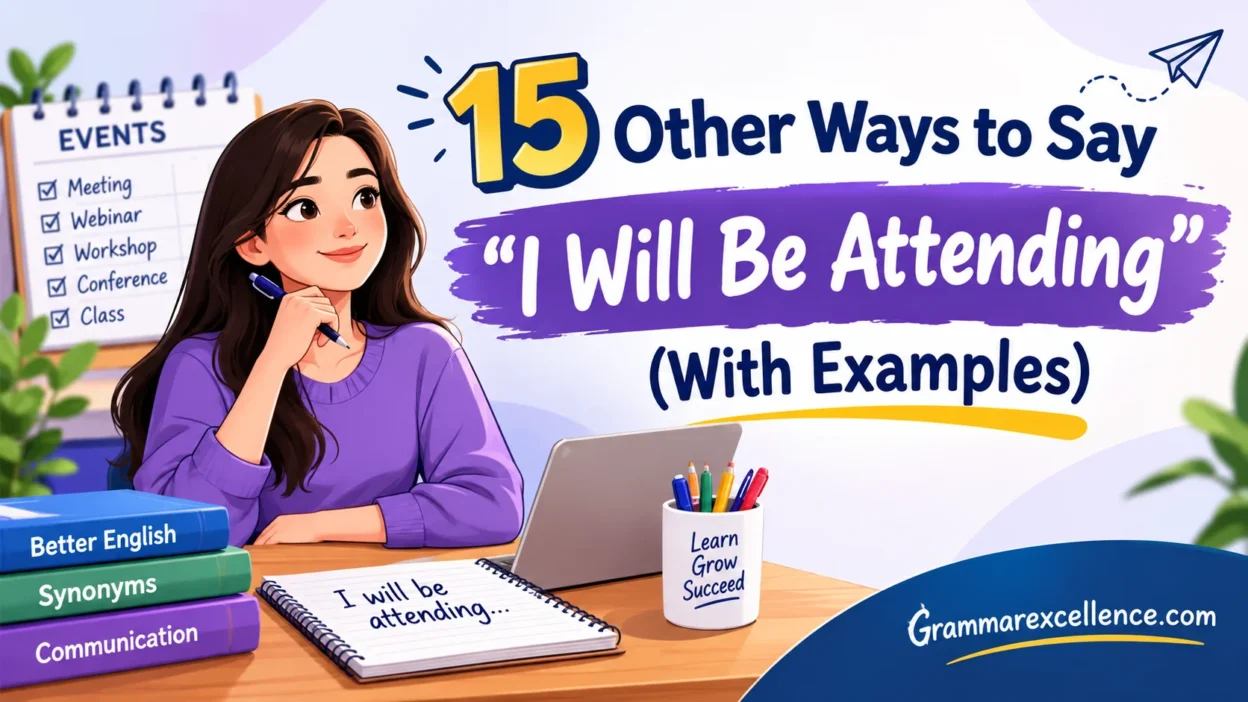
I Will Be Attending is a simple and professional way to confirm your participation in an event, meeting, or gathering, especially when you want your presence to be clear and polite.
When responding to a meeting invite, wedding RSVP, or work event email, this phrase sounds correct, natural, and widely understood. The right wording can also make your communication more casual, enthusiastic, or personal, depending on the situation and the person receiving your message.
In my experience, choosing suitable alternatives, along with their meanings, definitions, realistic examples, and guidance, makes it easier to express attendance naturally. A professional template can also help attract attendees, showcase speakers, present event details, and create a strong impression at an upcoming conference.
What Does “I Will Be Attending” Mean?
“I will be attending” means that you expect to be present at an event, meeting, class, gathering, appointment, or other planned activity in the future. The phrase uses the future form of attend, which means to go to and be present at something. For example, “I will be attending the conference on Friday” tells the listener that you intend or expect to be present at the conference. The wording is generally neutral to formal and is especially common in professional emails, invitations, announcements, and organized events.
The phrase can also communicate a fairly definite plan. However, the exact level of certainty depends on context. If someone says, “I will be attending the meeting,” they normally sound as though their attendance has already been decided rather than merely being considered.
Common Situations Where “I Will Be Attending” Is Used
“I will be attending” is commonly used when someone wants to confirm future attendance. It works naturally for business meetings, conferences, seminars, workshops, classes, weddings, ceremonies, appointments, and social events.
In workplace communication, the phrase can be useful when responding to an invitation or confirming participation. For example, an employee might write, “I will be attending the training session on Monday.” In personal communication, however, shorter alternatives such as “I’ll be there” or “I’m coming” may sound more relaxed.
People may also choose an alternative when they want to express something more specific. “I’m planning to attend” can show intention without absolute certainty, while “I’m looking forward to attending” adds enthusiasm.
Is It Professional or Polite to Say “I Will Be Attending”?
Yes. “I will be attending” is professional, polite, and grammatically correct in most formal and workplace situations. It has a straightforward tone and clearly communicates attendance without sounding overly emotional or informal.
The phrase may sound slightly formal in casual conversation. When speaking with a close friend, saying “I’ll be there” is usually more natural. In a business email, however, “I will be attending” can be an appropriate way to confirm your presence. The best wording depends on your relationship with the reader, the setting, and how certain you are about attending.
Advantages and Disadvantages of Saying “I Will Be Attending”
Advantages
The main advantage is clarity. The phrase tells the reader directly that you expect to be present. It also works well in professional communication because it sounds respectful and organized. Another benefit is that it can fit many situations, from meetings and conferences to formal ceremonies.
Disadvantages
The phrase can sometimes sound more formal than necessary, especially in casual conversation or friendly messages. It may also sound somewhat impersonal when you want to express excitement or warmth. If your attendance is only a possibility, “I will be attending” may communicate more certainty than you actually intend. In those cases, expressions such as “I’m planning to attend” or “I expect to attend” may be more accurate.
Synonyms For “I Will Be Attending”
- I’ll attend
- I’m planning to attend
- I’m going to attend
- I’ll be there
- I’m coming
- I intend to attend
- I expect to attend
- I’m scheduled to attend
- I’m due to attend
- I’m set to attend
- I’ll be joining
- I’m joining
- I plan to be there
- I’ll be present
- I’m looking forward to attending
1. I’ll Attend
Meaning
“I’ll attend” is a shorter and more direct way to say that you will be present at an event or activity.
Definition
I’ll attend means “I will attend” or “I will be present at the event.”
Detailed Explanation
This expression communicates a clear intention or decision to attend. Compared with “I will be attending,” it is shorter and more straightforward. It can sound professional without being unnecessarily formal. Because it is concise, it works particularly well when confirming an invitation or answering a direct question about attendance.
Scenario Examples
Scenario: A colleague asks whether you will attend a department meeting.
Example: “Yes, I’ll attend the meeting on Thursday.”
Scenario: You receive an invitation to a professional seminar.
Example: “Thank you for the invitation. I’ll attend.”
Best Use
Use “I’ll attend” for professional emails, confirmations, meetings, invitations, and straightforward conversations.
Tone
Tone: Direct, clear, and professional. It avoids unnecessary detail while clearly confirming your attendance.
2. I’m Planning to Attend
Meaning
“I’m planning to attend” shows that attending is your current intention, although it may not be completely certain.
Definition
I’m planning to attend means you currently intend or expect to go to an event.
Detailed Explanation
This phrase is useful when you want to communicate intention without making an absolute commitment. It is slightly less definite than “I will be attending.” That makes it suitable when circumstances could still change. It is also natural in both professional and everyday English.
Scenario Examples
Scenario: You are discussing an upcoming conference with a colleague.
Example: “I’m planning to attend the conference next month.”
Scenario: A friend asks whether you might come to a community event.
Example: “I’m planning to attend, although I may arrive a little late.”
Best Use
Use it for plans that are likely but not completely finalized, especially in conversations, emails, and informal professional communication.
Tone
Tone: Flexible, practical, and moderately confident. It leaves room for a change of plans.
3. I’m Going to Attend
Meaning
“I’m going to attend” communicates a future intention to be present at something.
Definition
I’m going to attend means you have decided or intend to go to an event or activity.
Detailed Explanation
This expression is common in everyday English and clearly communicates a future plan. It often sounds more conversational than “I will be attending.” Depending on the context, it can indicate a fairly firm decision. It is especially natural in spoken English, although it can also appear in informal writing.
Scenario Examples
Scenario: Your friend asks whether you are going to a concert.
Example: “Yes, I’m going to attend with my brother.”
Scenario: You tell a coworker about a training event.
Example: “I’m going to attend the afternoon session.”
Best Use
Use this phrase in everyday conversation, texting, informal workplace communication, and personal messages.
Tone
Tone: Conversational, natural, and confident. It sounds less formal than “I will be attending.”
4. I’ll Be There
Meaning
“I’ll be there” means that you will be present at the place or event being discussed.
Definition
I’ll be there means “I will be present” or “I will come to the event.”
Detailed Explanation
This is one of the most natural alternatives in casual English. Unlike “I will be attending,” it focuses on being present rather than the act of attending. It can sound warmer and more personal, particularly when someone has invited you to an event. The exact meaning depends on the context, because “there” must refer to a place or event already understood by both people.
Scenario Examples
Scenario: A friend invites you to a birthday dinner.
Example: “Thanks for inviting me. I’ll be there!”
Scenario: Your manager asks whether you will be at the meeting.
Example: “Yes, I’ll be there at 10.”
Best Use
Use it for friendly messages, casual conversations, invitations, meetings, and informal confirmations.
Tone
Tone: Friendly, warm, and reassuring. It feels more personal than the formal wording “I will be attending.”
5. I’m Coming
Meaning
“I’m coming” can mean that you intend to go to the place or event being discussed.
Definition
I’m coming means you are going to the place where the other person or group is, or you intend to join them.
Detailed Explanation
This expression is particularly natural when the destination is already clear. It is less formal than “I will be attending” and is often used in spoken English or texting. It can sometimes sound immediate, so it is not always the best replacement in a formal confirmation. In social situations, however, it can be friendly and enthusiastic.
Scenario Examples
Scenario: Friends are meeting at a restaurant and ask if you are joining them.
Example: “Yes, I’m coming. I’ll be there in about twenty minutes.”
Scenario: Your family is having a gathering.
Example: “Don’t start dinner without me—I’m coming!”
Best Use
Use it for casual conversation, texting, family communication, and social invitations.
Tone
Tone: Casual, friendly, and immediate. It sounds natural when the destination is already known.
6. I Intend to Attend
Meaning
“I intend to attend” communicates a clear intention to be present.
Definition
I intend to attend means you have a definite intention to go to an event or activity.
Detailed Explanation
This expression is more formal than “I’m planning to attend.” The word “intend” emphasizes deliberate intention and can sound serious or official. It is useful when you want to communicate a plan carefully without using the more conversational “I’m going to.” It can be appropriate in formal correspondence, although it may sound somewhat stiff in everyday conversation.
Scenario Examples
Scenario: You are responding formally to an organizational invitation.
Example: “I intend to attend the annual meeting.”
Scenario: You are writing a formal message about an upcoming academic event.
Example: “I intend to attend the conference and participate in the discussion.”
Best Use
Use it in formal correspondence, official communication, academic contexts, and serious professional situations.
Tone
Tone: Formal, deliberate, and respectful. The wording emphasizes intention rather than casual enthusiasm.
7. I Expect to Attend
Meaning
“I expect to attend” means that you believe you will attend, although there may still be some uncertainty.
Definition
I expect to attend means you currently believe that you will be present at an event.
Detailed Explanation
This phrase is useful when attendance is likely but not completely guaranteed. It therefore communicates confidence with some flexibility. Compared with “I will be attending,” it leaves more room for unexpected changes. The phrase works particularly well in professional communication when circumstances may affect your final attendance.
Scenario Examples
Scenario: You are responding to a conference organizer before your schedule is finalized.
Example: “I expect to attend the conference on Friday.”
Scenario: A colleague asks whether you will be available for a future meeting.
Example: “I expect to attend unless there is a change in my schedule.”
Best Use
Use it for professional communication, tentative confirmations, schedules, and situations where plans could change.
Tone
Tone: Professional, measured, and cautious. It communicates a strong expectation without making an absolute promise.
8. I’m Scheduled to Attend
Meaning
“I’m scheduled to attend” means that your attendance is part of an official or organized schedule.
Definition
I’m scheduled to attend means you are officially expected or arranged to be present at an event or activity.
Detailed Explanation
This expression focuses on the schedule or arrangement, rather than your personal desire to attend. It is particularly useful when an organization, employer, school, or event planner has already included you in the schedule. It can sound more formal and objective than “I’m planning to attend.” It does not necessarily mean you personally chose the event.
Scenario Examples
Scenario: Your employer has assigned you to a training session.
Example: “I’m scheduled to attend the training session on Monday.”
Scenario: A client asks when you will participate in a project meeting.
Example: “I’m scheduled to attend the meeting at 2 p.m.”
Best Use
Use it for work schedules, training, appointments, conferences, official events, and organized activities.
Tone
Tone: Professional, factual, and organized. It emphasizes an established schedule.
9. I’m Due to Attend
Meaning
“I’m due to attend” means that you are expected or scheduled to attend at a particular future time.
Definition
I’m due to attend means you are expected to be present at an arranged future event.
Detailed Explanation
This expression is more common in British English and formal contexts. It often suggests that an event has already been arranged and that your attendance is expected. It can sound more official than “I’m planning to attend.” Because of this, it is more suitable for workplace, institutional, or formal communication than casual conversation.
Scenario Examples
Scenario: A formal schedule includes your participation in a meeting.
Example: “I’m due to attend the committee meeting next Tuesday.”
Scenario: You are explaining your upcoming work commitments.
Example: “I’m due to attend a training session later this week.”
Best Use
Use it in formal or professional communication, particularly when discussing scheduled responsibilities or appointments.
Tone
Tone: Formal, organized, and somewhat official. It is especially natural in British-style professional English.
10. I’m Set to Attend
Meaning
“I’m set to attend” means that you are prepared, arranged, or expected to attend.
Definition
I’m set to attend means you are ready or scheduled to be present at an event.
Detailed Explanation
This expression suggests that the arrangements are largely in place. It can communicate confidence and readiness without sounding as formal as “I’m scheduled to attend.” The phrase is common in news-style writing and professional communication, but it can also appear in ordinary conversation. It is useful when you want to emphasize that attendance is already arranged.
Scenario Examples
Scenario: You have confirmed your participation in a business event.
Example: “I’m set to attend the leadership conference next week.”
Scenario: A friend asks whether your plans for the weekend are confirmed.
Example: “Yes, I’m set to attend the family gathering on Saturday.”
Best Use
Use it for confirmed plans, professional events, organized activities, and situations where preparation is complete.
Tone
Tone: Confident, prepared, and moderately formal. It suggests that the plan is already in place.
11. I’ll Be Joining
Meaning
“I’ll be joining” means that you will participate in or become part of an event, meeting, group, or activity.
Definition
I’ll be joining means you will take part in an event or connect with a group at a future time.
Detailed Explanation
This phrase emphasizes participation and connection rather than simply being physically present. It is especially natural for online meetings, group discussions, classes, and social gatherings. Compared with “I will be attending,” it can sound more active and inclusive. It is therefore useful when your role involves participating rather than simply sitting in the audience.
Scenario Examples
Scenario: A team is holding an online meeting.
Example: “I’ll be joining the meeting at 11 a.m.”
Scenario: Friends are organizing a group dinner.
Example: “I’ll be joining you for dinner after work.”
Best Use
Use it for meetings, online calls, group activities, social events, classes, and collaborative situations.
Tone
Tone: Friendly, active, and collaborative. It highlights your participation in the group.
12. I’m Joining
Meaning
“I’m joining” indicates that you are going to participate in or become part of an event or gathering.
Definition
I’m joining means you are taking part in an activity or going to be part of a group or event.
Detailed Explanation
This is a concise and conversational expression. It often works best when the event or group is already clear from the conversation. “I’m joining” can feel more immediate than “I will be attending,” particularly when someone is asking who will participate. It is also widely useful for digital meetings and informal group activities.
Scenario Examples
Scenario: Your coworkers are starting a video meeting.
Example: “I’m joining now—give me one minute.”
Scenario: Friends are planning a weekend activity.
Example: “I’m joining you guys for the hike.”
Best Use
Use it in casual conversation, workplace chats, online meetings, group activities, and social messages.
Tone
Tone: Casual, active, and approachable. It sounds natural when participation is the main idea.
13. I Plan to Be There
Meaning
“I plan to be there” communicates that you intend to be present at the event or place being discussed.
Definition
I plan to be there means you currently intend to attend or be present.
Detailed Explanation
This phrase is a natural alternative when you want to communicate a plan without making it sound completely fixed. It is similar to “I’m planning to attend,” but “be there” sounds more conversational and personal. It works particularly well when the event has already been mentioned. The phrase can also sound reassuring when responding to an invitation.
Scenario Examples
Scenario: A friend asks whether you will come to their graduation.
Example: “Of course—I plan to be there.”
Scenario: A colleague asks about an upcoming team event.
Example: “I plan to be there unless something urgent comes up.”
Best Use
Use it for friendly communication, personal messages, informal workplace conversations, and invitations.
Tone
Tone: Warm, conversational, and moderately confident. It communicates intention while allowing some flexibility.
14. I’ll Be Present
Meaning
“I’ll be present” means that you will physically or officially be at the event.
Definition
I’ll be present means you will be in attendance at a particular event, meeting, or occasion.
Detailed Explanation
This phrase is more formal than many alternatives on this list. It emphasizes presence rather than the act of attending. It can be useful when attendance is important or when the setting has an official tone. In casual conversation, however, “I’ll be there” will usually sound more natural.
Scenario Examples
Scenario: A manager needs confirmation for an important meeting.
Example: “I’ll be present at the meeting and available for questions.”
Scenario: You are responding to a formal invitation.
Example: “Thank you for the invitation. I’ll be present at the ceremony.”
Best Use
Use it for formal emails, official meetings, ceremonies, professional communication, and situations where physical presence matters.
Tone
Tone: Formal, respectful, and direct. It gives attendance an official or serious feel.
15. I’m Looking Forward to Attending
Meaning
“I’m looking forward to attending” means that you expect to attend and feel positive or enthusiastic about the event.
Definition
I’m looking forward to attending means you are pleased or excited about the opportunity to attend something.
Detailed Explanation
Unlike “I will be attending,” this expression adds an important emotional element: anticipation. It is particularly useful when you want to confirm attendance while also showing appreciation or enthusiasm. It is common in professional emails, event confirmations, conferences, interviews, and invitations. It should not be used if you simply want to give a neutral confirmation without expressing positive anticipation.
Scenario Examples
Scenario: You have accepted an invitation to a professional conference.
Example: “Thank you for the invitation. I’m looking forward to attending the conference.”
Scenario: You are confirming your participation in a workshop.
Example: “I’m looking forward to attending the workshop and meeting the other participants.”
Best Use
Use it for professional emails, formal invitations, conferences, workshops, ceremonies, and situations where you genuinely want to express enthusiasm.
Tone
Tone: Warm, positive, professional, and enthusiastic. It adds appreciation and anticipation to a simple attendance confirmation.
FAQs
Q1. What is another way to say “I will be attending”?
There are several natural alternatives, including “I’ll attend,” “I’m planning to attend,” “I’ll be there,” “I intend to attend,” and “I’m looking forward to attending.” The best choice depends on whether you want to sound casual, formal, tentative, or enthusiastic.
Q2. What does “I will be attending” mean?
“I will be attending” means that you expect to be present at a future event or activity. It is commonly used for meetings, conferences, classes, ceremonies, appointments, and other planned occasions.
Q3. Is “I will be attending” professional?
Yes. “I will be attending” is professional and polite and works well in workplace emails, formal invitations, conferences, and official communication. In casual conversations, shorter expressions such as “I’ll be there” may sound more natural.
Q4. What is a more polite way to say “I will be attending”?
The original phrase is already polite. If you want to add warmth and appreciation, you can say, “I’m looking forward to attending.” For a formal confirmation, “I’ll be present” or “I intend to attend” may also fit, depending on the context.
Q5. Which alternative works best in formal communication?
For formal communication, “I will be attending,” “I intend to attend,” “I’m scheduled to attend,” and “I’ll be present” can all work well. Choose according to the meaning: “scheduled” emphasizes an official arrangement, “intend” emphasizes your decision, and “present” emphasizes your presence.
Conclusion
I Will Be Attending is a clear and useful expression for confirming your attendance, participation, or presence. It works well in professional and personal situations, including a meeting, event, wedding RSVP, or work event. Choosing the right wording can make your communication sound more natural, polite, and appropriate. By understanding different alternatives, their meanings, and practical examples, you can confidently select an expression that matches your situation and communicates your plans clearly.