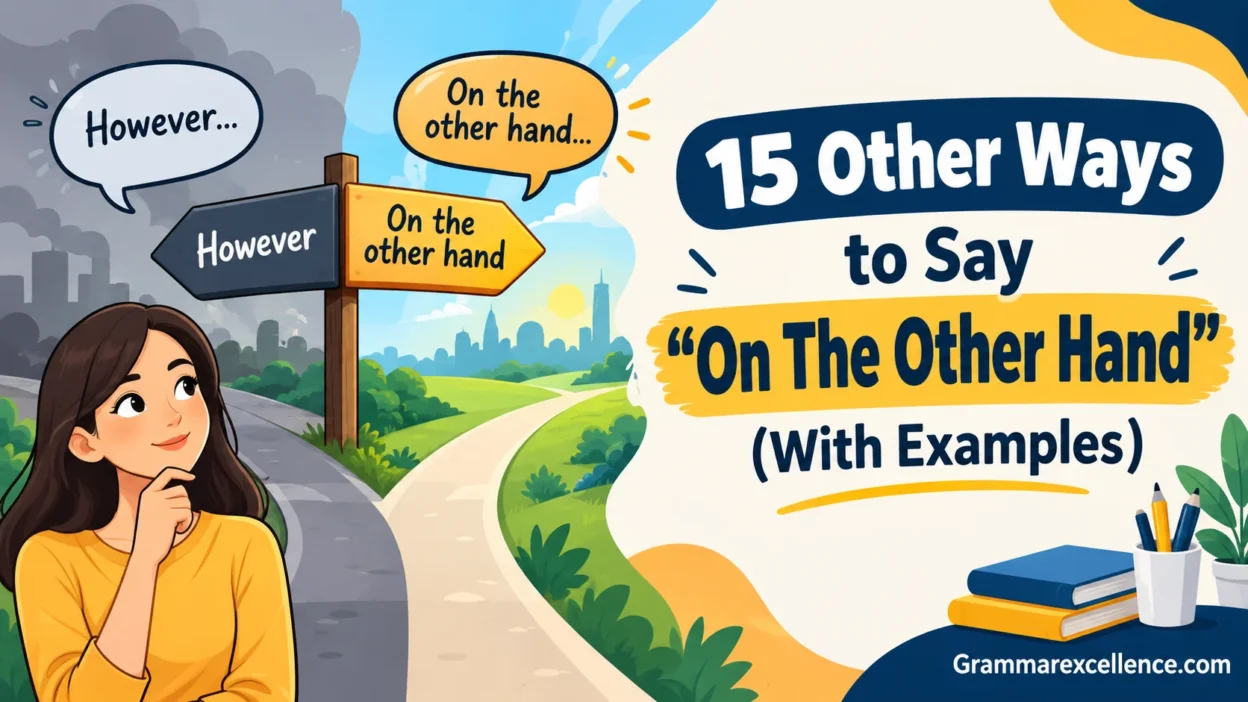
On The Other Hand is a useful phrase when you want to show a different side of an idea, situation, or opinion. It helps connect two contrasting points in a natural way, especially when one statement presents an option and the next introduces another perspective. On The Other Hand can make everyday communication, essays, emails, and professional writing clearer because it signals that the discussion is moving to another side.
In my experience with English writing, On The Other Hand works best when the second point has a clear connection to the first. For example, you might say that a busy city offers more jobs; on the other hand, it may also have higher living costs. The phrase therefore helps compare two sides without making the sentence difficult to understand, and it can introduce a contrasting idea, different point of view, or alternative situation.
You can also use On The Other Hand when balancing opinions in a conversation or explaining two sides of the same topic. It is especially helpful when you want your writing to have better flow, balance, and clarity. The key is to use it where the following statement genuinely contrasts with, or offers another perspective on, what came before.
What Does “On The Other Hand” Mean?
“On the other hand” is an expression used to introduce a contrasting point, different perspective, or alternative consideration. It usually appears when someone has mentioned one side of an issue and wants to discuss another side.
For example, you might say, “The apartment is affordable. On the other hand, it is quite far from work.” The phrase signals that the second statement presents a different or contrasting consideration. It does not necessarily mean that the second point completely contradicts the first; instead, it often helps create a more balanced view of a situation.
Common Situations Where “On The Other Hand” Is Used
“On the other hand” is common in everyday conversation, personal messages, discussions, essays, presentations, and professional communication. Someone might use it when comparing two choices, discussing advantages and disadvantages, or acknowledging another person’s perspective.
In writing, it is especially useful when you want to move from one argument to a contrasting argument. In conversation, it can help you reconsider something without completely rejecting what you said earlier.
People may choose an alternative when they want a shorter, more formal, more casual, or more precise expression. For example, “by contrast” can sound more formal, while “on the flip side” is much more conversational.
Is It Professional or Polite to Say “On The Other Hand”?
Yes. “On the other hand” is generally professional, polite, and neutral. It works well in workplace discussions, presentations, emails, essays, and ordinary conversation. It does not normally sound rude or overly formal.
Its suitability depends mainly on the surrounding sentence. In formal writing, alternatives such as “by contrast” or “in contrast” may sometimes create a more concise academic style. In relaxed conversation, expressions such as “then again” or “on the flip side” can feel more natural.
Advantages and Disadvantages of Saying “On The Other Hand”
Advantages
The main advantage of “on the other hand” is its clarity. Most English speakers immediately understand that a contrasting idea is coming. It is also flexible enough for spoken and written English, from friendly conversations to professional discussions. The expression can make an argument sound balanced because it acknowledges another side instead of presenting only one viewpoint.
Disadvantages
The phrase can become repetitive if it appears several times in the same piece of writing. It can also be slightly wordy when a shorter expression such as “however” or “by contrast” would communicate the relationship more efficiently. In very casual conversation, some speakers may prefer a more natural expression such as “then again” or “on the flip side.”
Synonyms For “On The Other Hand”
- By contrast
- In contrast
- Conversely
- On the flip side
- Then again
- That said
- At the same time
- From another perspective
- From another point of view
- Looking at it another way
- In comparison
- Alternatively
- Whereas
- While
- In a different respect
1. By contrast
Meaning
“By contrast” introduces a clear difference between two people, things, situations, or ideas. It is particularly useful when the contrast is strong and easy to identify.
Definition
By contrast means when compared with something else, the difference becomes clear.
Detailed Explanation
This expression is often more formal and concise than “on the other hand.” It works especially well in essays, reports, presentations, and analytical writing. Unlike “on the other hand,” it commonly emphasizes a direct difference rather than simply presenting another consideration.
Scenario Examples
Scenario: Comparing two neighborhoods.
Example: “The city center is crowded and expensive. By contrast, the suburbs are quieter and more affordable.”
Scenario: Discussing two employees’ working styles.
Example: “Ali prefers detailed planning. By contrast, Sara makes decisions quickly.”
Best Use
Best for formal writing, reports, comparisons, academic discussions, and professional communication.
Tone
Tone: Formal, analytical, direct.
It sounds polished because it focuses specifically on the difference between two things.
2. In contrast
Meaning
“In contrast” signals that the next point is noticeably different from the previous one.
Definition
In contrast means showing a difference between two ideas, situations, or things.
Detailed Explanation
This is one of the closest alternatives to “on the other hand” when your main purpose is to show difference. It is common in both spoken and written English, although it has a slightly more formal feel in many contexts. It is particularly useful when comparing characteristics rather than weighing two sides of a decision.
Scenario Examples
Scenario: Describing two seasons.
Example: “Summer here is hot and dry. In contrast, winter is cool and rainy.”
Scenario: Comparing two products.
Example: “The first model is lightweight. In contrast, the second is designed for heavy-duty use.”
Best Use
Best for comparisons, essays, reports, presentations, and explanatory writing.
Tone
Tone: Neutral, clear, professional.
It communicates contrast without sounding emotional or confrontational.
3. Conversely
Meaning
“Conversely” introduces an idea that is opposite or reversed in relation to the previous point.
Definition
Conversely means in an opposite or reversed way.
Detailed Explanation
This word is more precise than “on the other hand” when the second statement represents a reverse relationship. It is common in formal and academic writing and is less frequent in casual conversation. Because it can sound sophisticated, it should be used when the relationship between the two ideas is genuinely opposite or reciprocal.
Scenario Examples
Scenario: Discussing cause and effect.
Example: “Higher demand can increase prices. Conversely, lower demand may cause prices to fall.”
Scenario: Explaining two opposing reactions.
Example: “Some employees become more productive with flexible hours. Conversely, others work better with a fixed schedule.”
Best Use
Best for academic writing, analytical articles, reports, and formal explanations.
Tone
Tone: Formal, analytical, precise.
It is stronger than a simple contrast because it often suggests an opposite relationship.
4. On the flip side
Meaning
“On the flip side” introduces the other side of a situation, especially when discussing a benefit alongside a drawback.
Definition
On the flip side means considering the opposite or less favorable side of something.
Detailed Explanation
This is a casual and conversational alternative to “on the other hand.” It often sounds more relaxed and approachable. It works particularly well when talking about advantages and disadvantages, although it may feel too informal for some academic or highly formal documents.
Scenario Examples
Scenario: Talking about remote work.
Example: “Working from home saves commuting time. On the flip side, it can be harder to separate work from personal life.”
Scenario: Discussing a new phone.
Example: “The camera is excellent. On the flip side, the battery could be better.”
Best Use
Best for conversation, blogs, social media, informal messages, and friendly communication.
Tone
Tone: Casual, friendly, conversational.
It makes a contrast feel less formal and more approachable.
5. Then again
Meaning
“Then again” introduces a different thought that makes you reconsider or qualify what you just said.
Definition
Then again means considering another fact or possibility that changes the way the first point should be viewed.
Detailed Explanation
This phrase is slightly different from a straightforward contrast. It often suggests reconsideration, hesitation, or a second thought. It is natural when someone changes perspective after thinking about another factor.
Scenario Examples
Scenario: Deciding whether to buy an expensive laptop.
Example: “It costs more than I planned. Then again, I use my laptop every day.”
Scenario: Discussing a friend’s decision.
Example: “He could have accepted the job. Then again, the commute would have been difficult.”
Best Use
Best for conversation, personal messages, informal discussions, and reflective writing.
Tone
Tone: Thoughtful, conversational, slightly hesitant.
It often shows that the speaker is reconsidering a decision or opinion.
6. That said
Meaning
“That said” introduces a qualification or contrasting point after acknowledging what was just stated.
Definition
That said means despite what has just been mentioned, another point should also be considered.
Detailed Explanation
This expression is useful when you want to acknowledge one point without completely accepting its conclusion. It is concise and natural in modern English. It can work in professional writing while still sounding conversational.
Scenario Examples
Scenario: Giving feedback to a colleague.
Example: “The presentation was well organized. That said, the final section needed more detail.”
Scenario: Reviewing a restaurant.
Example: “The food was excellent. That said, the service was slower than expected.”
Best Use
Best for professional emails, reviews, articles, discussions, and thoughtful conversation.
Tone
Tone: Balanced, respectful, measured.
It helps introduce disagreement or qualification without sounding unnecessarily harsh.
7. At the same time
Meaning
“At the same time” can introduce another consideration that exists alongside the first one.
Definition
At the same time means while recognizing one fact, another fact is also true or important.
Detailed Explanation
This expression is not always a direct synonym for “on the other hand.” It is most useful when two ideas can both be true simultaneously. It often sounds softer than a direct contrast because it does not necessarily suggest that one point cancels out the other.
Scenario Examples
Scenario: Giving balanced feedback.
Example: “The project was challenging. At the same time, it gave the team valuable experience.”
Scenario: Discussing a busy lifestyle.
Example: “I enjoy being busy. At the same time, I need some quiet time to recharge.”
Best Use
Best for personal communication, workplace discussions, reflective writing, and balanced arguments.
Tone
Tone: Balanced, gentle, thoughtful.
It works well when you want to recognize two truths at once.
8. From another perspective
Meaning
“From another perspective” introduces a different way of looking at an issue.
Definition
From another perspective means considering the same situation from a different point of view.
Detailed Explanation
This phrase focuses more on perspective than direct contradiction. It is useful when two people may interpret the same situation differently. It can make disagreement sound constructive because it emphasizes another viewpoint rather than declaring the first viewpoint wrong.
Scenario Examples
Scenario: Discussing a workplace policy.
Example: “The new schedule may be inconvenient. From another perspective, it gives employees more flexibility.”
Scenario: Talking about a difficult decision.
Example: “The decision was disappointing for the team. From another perspective, it may prevent bigger problems later.”
Best Use
Best for professional communication, discussions, essays, presentations, and thoughtful personal conversations.
Tone
Tone: Respectful, thoughtful, diplomatic.
It is particularly useful when discussing different viewpoints.
9. From another point of view
Meaning
“From another point of view” presents an issue from a different person’s or perspective’s position.
Definition
From another point of view means considering something from a different perspective or way of thinking.
Detailed Explanation
This expression is close to “from another perspective,” but it can sound slightly more explicit and explanatory. It is helpful when you want readers or listeners to imagine how the same issue might appear to someone else. It does not necessarily indicate a direct contradiction.
Scenario Examples
Scenario: Discussing a customer complaint.
Example: “The policy may seem strict to customers. From another point of view, it protects the company from repeated problems.”
Scenario: Talking about a disagreement between friends.
Example: “I understand why she was upset. From another point of view, he may not have realized how his words sounded.”
Best Use
Best for discussions, explanations, educational writing, and personal communication.
Tone
Tone: Neutral, empathetic, explanatory.
It encourages the reader to consider someone else’s viewpoint.
10. Looking at it another way
Meaning
“Looking at it another way” suggests examining the same situation differently.
Definition
Looking at it another way means considering the same idea from a different angle.
Detailed Explanation
This is a natural, conversational expression that can soften a change in perspective. It is particularly useful when explaining an idea to someone who may initially see things differently. Rather than presenting a sharp contradiction, it invites the listener to reframe the situation.
Scenario Examples
Scenario: Encouraging a student after a disappointing result.
Example: “You didn’t get the grade you wanted. Looking at it another way, now you know exactly what you need to improve.”
Scenario: Discussing a business expense.
Example: “The equipment is expensive. Looking at it another way, it could reduce costs over several years.”
Best Use
Best for conversation, coaching, personal messages, presentations, and explanatory writing.
Tone
Tone: Friendly, encouraging, constructive.
It feels less confrontational because it asks someone to reframe an idea.
11. In comparison
Meaning
“In comparison” introduces a point by comparing it with something previously mentioned.
Definition
In comparison means when something is considered alongside another thing.
Detailed Explanation
This phrase is most useful when the relationship is explicitly comparative. It is not always interchangeable with “on the other hand,” because it can simply highlight differences in degree or characteristics. It works especially well when describing two options or measurable qualities.
Scenario Examples
Scenario: Comparing two hotels.
Example: “The first hotel has basic rooms. In comparison, the second offers larger rooms and more facilities.”
Scenario: Discussing two workloads.
Example: “Last month was extremely busy. In comparison, this month has been much calmer.”
Best Use
Best for comparisons, reports, reviews, essays, and descriptive writing.
Tone
Tone: Neutral, analytical, objective.
It emphasizes comparison rather than disagreement.
12. Alternatively
Meaning
“Alternatively” introduces another option, possibility, or course of action.
Definition
Alternatively means as another possibility or choice.
Detailed Explanation
This word differs from “on the other hand” because it usually presents an alternative choice, rather than simply a contrasting fact. It is especially useful when discussing what someone could do instead. It is common in professional and formal writing.
Scenario Examples
Scenario: Giving travel advice.
Example: “You can take the train. Alternatively, you could travel by bus.”
Scenario: Discussing a work process.
Example: “We could hold the meeting on Monday. Alternatively, we could schedule it for Wednesday.”
Best Use
Best for professional emails, instructions, planning, formal writing, and decision-making.
Tone
Tone: Professional, practical, direct.
It focuses on another available option, not necessarily an opposing viewpoint.
13. Whereas
Meaning
“Whereas” connects two clauses to show a direct difference between them.
Definition
Whereas means while one thing is true, another contrasting thing is true.
Detailed Explanation
Unlike “on the other hand,” whereas is a conjunction, so it normally connects two parts of a sentence. It is useful when comparing people, things, or situations directly. It often sounds more formal and compact than using a separate sentence.
Scenario Examples
Scenario: Comparing two products.
Example: “This model is designed for beginners, whereas the premium version targets experienced users.”
Scenario: Comparing work preferences.
Example: “Ahmed prefers working alone, whereas Maria enjoys collaborating with a team.”
Best Use
Best for formal writing, comparisons, reports, academic work, and professional communication.
Tone
Tone: Formal, precise, comparative.
It creates a clear grammatical connection between two contrasting facts.
14. While
Meaning
“While” can introduce a contrasting idea when two statements are being compared.
Definition
While can mean although one thing is true, another contrasting thing is also true.
Detailed Explanation
“While” is highly flexible and common in everyday English. It can express contrast, concession, or time, so the surrounding sentence determines its meaning. In contrastive writing, it can make a sentence smoother and less repetitive than repeatedly using “on the other hand.”
Scenario Examples
Scenario: Discussing two sides of a decision.
Example: “While the new system takes time to learn, it can make the process much faster.”
Scenario: Talking about different preferences.
Example: “While I enjoy city life, I sometimes miss the quiet of the countryside.”
Best Use
Best for everyday conversation, essays, professional writing, and balanced statements.
Tone
Tone: Natural, flexible, balanced.
It often sounds smoother because the contrast is built directly into the sentence.
15. In a different respect
Meaning
“In a different respect” introduces another aspect or characteristic of the same subject.
Definition
In a different respect means when considered in another particular aspect or regard.
Detailed Explanation
This expression is more specific than “on the other hand.” It is useful when something can be viewed differently depending on the particular aspect being considered. Because it is relatively formal, it is better suited to careful writing than casual conversation.
Scenario Examples
Scenario: Evaluating an employee.
Example: “She is highly experienced in customer service. In a different respect, she still needs training in data analysis.”
Scenario: Discussing a city.
Example: “The city is expensive for housing. In a different respect, public transportation is remarkably affordable.”
Best Use
Best for formal writing, evaluations, reports, analytical discussions, and detailed comparisons.
Tone
Tone: Formal, precise, analytical.
It helps distinguish between different aspects of the same subject rather than presenting a simple opposite.
FAQs
Q1. What is another way to say “On The Other Hand”?
There are several alternatives, including “by contrast,” “in contrast,” “that said,” “then again,” and “from another perspective.” The best choice depends on whether you want to show a direct contrast, introduce another viewpoint, reconsider a point, or present another consideration.
Q2. What does “On The Other Hand” mean?
“On the other hand” introduces a contrasting or different point of view. It is commonly used after one idea has been presented to show that another fact, opinion, advantage, or disadvantage should also be considered.
Q3. Is “On The Other Hand” professional?
Yes. “On the other hand” is professional and neutral in most contexts. It can be used in workplace communication, presentations, essays, reports, and formal discussions. For a more concise formal style, “by contrast” or “in contrast” may sometimes be more suitable.
Q4. What is a more polite way to say “On The Other Hand”?
The original phrase is already generally polite. If you want to make a disagreement or alternative viewpoint sound especially diplomatic, expressions such as “from another perspective” or “that said” can work well.
Q5. Which alternative works best in formal communication?
There is no single choice for every situation. “By contrast” and “in contrast” work well for clear comparisons, “conversely” suits an opposite relationship, and “alternatively” is useful when presenting another option. The context should determine the wording.
Conclusion
On The Other Hand is a simple and effective phrase for introducing a contrasting idea, alternative perspective, or different side of a situation. Using it in the right context can make everyday communication and formal writing more balanced, clear, and natural.